
Studio of Denis Calvaert
(Antwerp 1540 – 1619 Bologna)
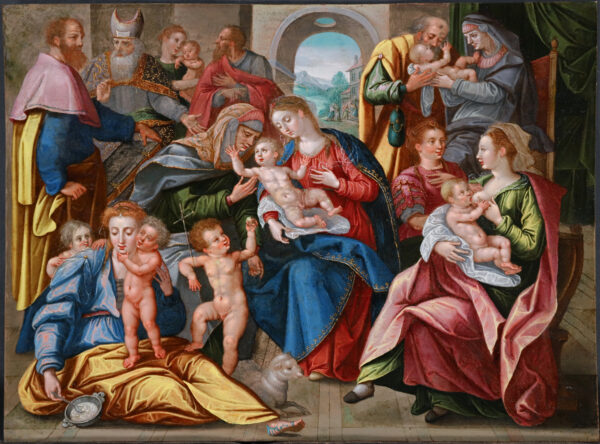
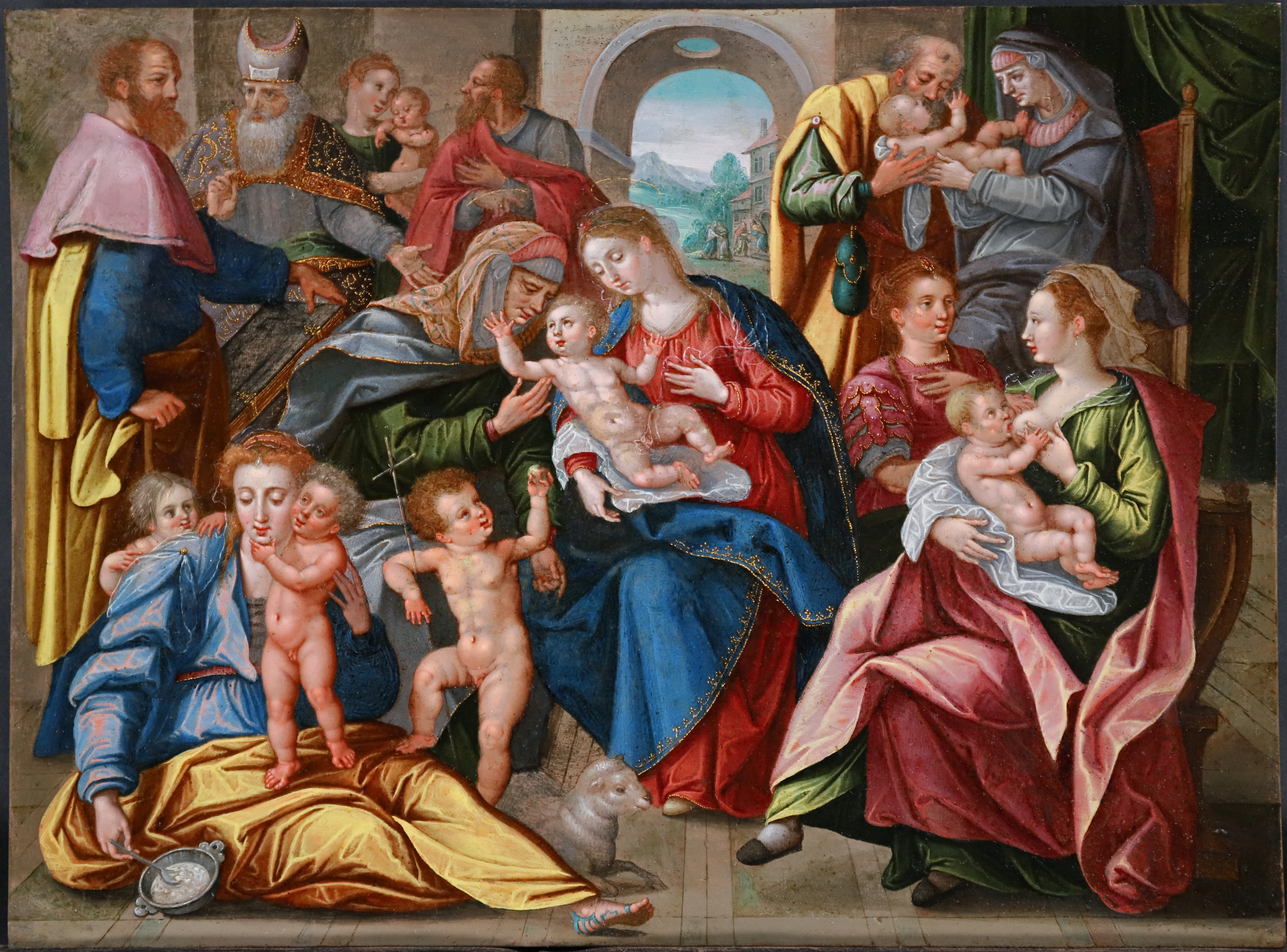
“The Holy Kinship”, c. 1600
Oil on copper: 22 x 16 cm
"*" indicates required fields
Notes
The painting depicts the “Holy Kinship” (or the Family of Christ / Kinship of the Virgin), an iconographic subject showing Christ’s extended family, including Mary, the Christ Child, Saint Anna, Saint Joseph, Elizabeth, and a young John the Baptist.
The Holy Kinship was the extended family of Jesus supposedly descended from his maternal grandmother Saint Anne through her trinubium or three marriages. The legend concerning the life of Saint Anne emerged in the 13th century. According to this legend, Anne (the mother of the Virgin Mary and thus grandmother of Jesus) married three times, having one daughter from each marriage. She was already an elderly woman when she gave birth to Mary, the mother of Christ. In the painting, Mary sits in the center with the Child on her lap. Beside her sits her cousin Elizabeth—rather than her mother, Saint Anne, as would typically be the case. Standing before Elizabeth is her son, John the Baptist. In the elderly couple to the right of the arcade, we recognize Anne and her third husband, Joachim, together with their daughter, Mary. Seated in the foreground on the left and right are Mary’s half-sisters. In the background, from left to right, we see Zebedee, Zechariah, and Joseph—the husbands of Mary’s half-sister, of Elizabeth, and of Mary, respectively. A view through the architecture reveals the scene of the meeting between Mary and Elizabeth.
The group were a popular subject in religious art throughout Germany and the Low Countries, especially during the late 15th and early 16th centuries, but rarely after the Council of Trent. (see example below by Geertgen tot Sint Jans, c. 1490)
After the Council of Trent dismissed the legend of the three marriages of Anne, the full subject was thereafter rarely painted, although the limited group of the families of the cousins Jesus and John the Baptist remained in use.
The Council of Trent (1545–1563) was the 19th ecumenical council of the Roman Catholic Church, convened as the definitive response to the Protestant Reformation. Spanning 18 years and three distinct periods in Trent, Italy, it established the theological and disciplinary foundations of the Catholic Counter-Reformation, modernizing church administration while firmly rejecting Protestant theology. During these years, the legend of Saint Anne was officially dismissed.
Art historians have identified this composition as a direct copy after a known design “The Family of Saint Anne” by the Flemish master Marten de Vos (1532–1603). The original composition was painted in 1585 and is currently exhibited in the permanent collection of the Museum of Fine Arts Ghent (MSK), in Belgium.
From 1577 to 1584, Ghent was ruled as a radical Calvinist Republic, during which Catholic worship was banned, and many church altarpieces were destroyed or removed. In September 1584, Spanish Catholic forces under Alexander Farnese recaptured Ghent, forcing a swift Counter-Reformation recatholicization.
To rapidly re-furnish the stripped bare chapels, prominent religious brotherhoods or wealthy private citizens commissioned Antwerp’s top artist, Maerten de Vos. Completed in 1585, the monumental panel was installed as a devotional altarpiece inside a prominent Ghent church or confraternity chapel.
During this era, Maerten de Vos was the preeminent painter of altarpieces in Counter-Reformation Antwerp. Because De Vos was one of the most prolific print designers of his era, his Holy Kinship composition reached a massive European audience through authorized engravings.
One of these, engraved and edited by Raphael Sadeler I, this print was based entirely on an original drawing by De Vos. It bears the plate signature “Raph. Sadeler excudit, Martin. de Vos inv.” and features the Latin title “Sancta ac venerabilis Christi familia”. This engraving was distributed widely across Europe during the latter years.
This current version on copper is executed in the highly stylized, elongated Northern Mannerist aesthetic, it is most likely the work of a skilled independent master or a directly trained workshop specialist. Given that it is painted on copper—a medium famous for capturing intense detail and luminous glazes—several notable painters from Maerten de Vos’s immediate circle, workshop, or generational orbit could have executed it.
Denis Calvaert (ca. 1540–1619) is however, a highly compelling candidate for this small-scale oil-on-copper (ca. 1600). While he was a direct contemporary of Maerten de Vos rather than his apprentice, Calvaert’s specific career, location, and artistic signature fit the profile perfectly.
While Calvaert was born in Antwerp, he moved to Bologna around 1560 and became famous for introducing the Flemish technique of painting exquisite, jewel-like religious scenes on copper plates (oil on copper) to the Italian market.
His surviving oeuvre is dominated by works like The Holy Family with the Infant Saint John the Baptist in a Landscape and The Holy Family with Saint Stephen. He spent decades perfecting multi-figured, intimate family groupings that dynamically mirror the theological layout of De Vos’s Holy Kinship.
Though Calvaert established his famous art academy in Bologna (training superstars like Guido Reni and Domenichino), he never severed ties with his homeland. He remained a deep admirer of Antwerp Mannerism: Calvaert’s workshop heavily relied on Antwerp print culture. Engravings after Maerten de Vos flooded Italian markets in those decades. We believe the engraving by Raphael Sadeler I, of De Vos’s original Saint Anne painting, found its way into Calvaert’s Italian studio. The painting on copper could have been made by the master himself or under his supervision in his workshop. Calvaert systematically used these prints to teach his students layout, posture, and line structure.
Denis Calvaert was a prominent Flemish Mannerist painter and draftsperson who spent the vast majority of his career in Italy. Known locally as Dionisio Fiammingo (“the Fleming”), he served as a crucial artistic bridge by fusing northern European precision in landscape painting with the sweeping grace, anatomy, and vibrant colour of the Italian Renaissance.
Provenance
- Private collection, Germany
- Remco van Leeuwen Antiquair
- Private collection, The Netherlands