
![Rembrandt van Rijn etching for sale / ets te koop / gravure a vendre - The Virgin and child in the clouds, 1641 [CM26-BK] f](https://douwesfineart.com/wp-content/uploads/2026/03/Rembrandt-van-Rijn-The-Virgin-and-child-in-the-clouds-1641-kf-CM26-BK-384x600.jpg)
![Rembrandt van Rijn etching for sale / ets te koop / gravure a vendre - The Virgin and child in the clouds, 1641 [CM26-BK]](https://douwesfineart.com/wp-content/uploads/2026/03/Rembrandt-van-Rijn-The-Virgin-and-child-in-the-clouds-1641-CM26-BK-485x600.jpg)
![Rembrandt van Rijn etching for sale / ets te koop / gravure a vendre - The Virgin and child in the clouds, 1641 [CM26-BK] f](https://douwesfineart.com/wp-content/uploads/2026/03/Rembrandt-van-Rijn-The-Virgin-and-child-in-the-clouds-1641-kf-CM26-BK-64x100.jpg)
![Rembrandt van Rijn etching for sale / ets te koop / gravure a vendre - The Virgin and child in the clouds, 1641 [CM26-BK]](https://douwesfineart.com/wp-content/uploads/2026/03/Rembrandt-van-Rijn-The-Virgin-and-child-in-the-clouds-1641-CM26-BK-81x100.jpg)
Rembrandt Harmensz. van Rijn
(Leiden 1606-1669 Amsterdam)
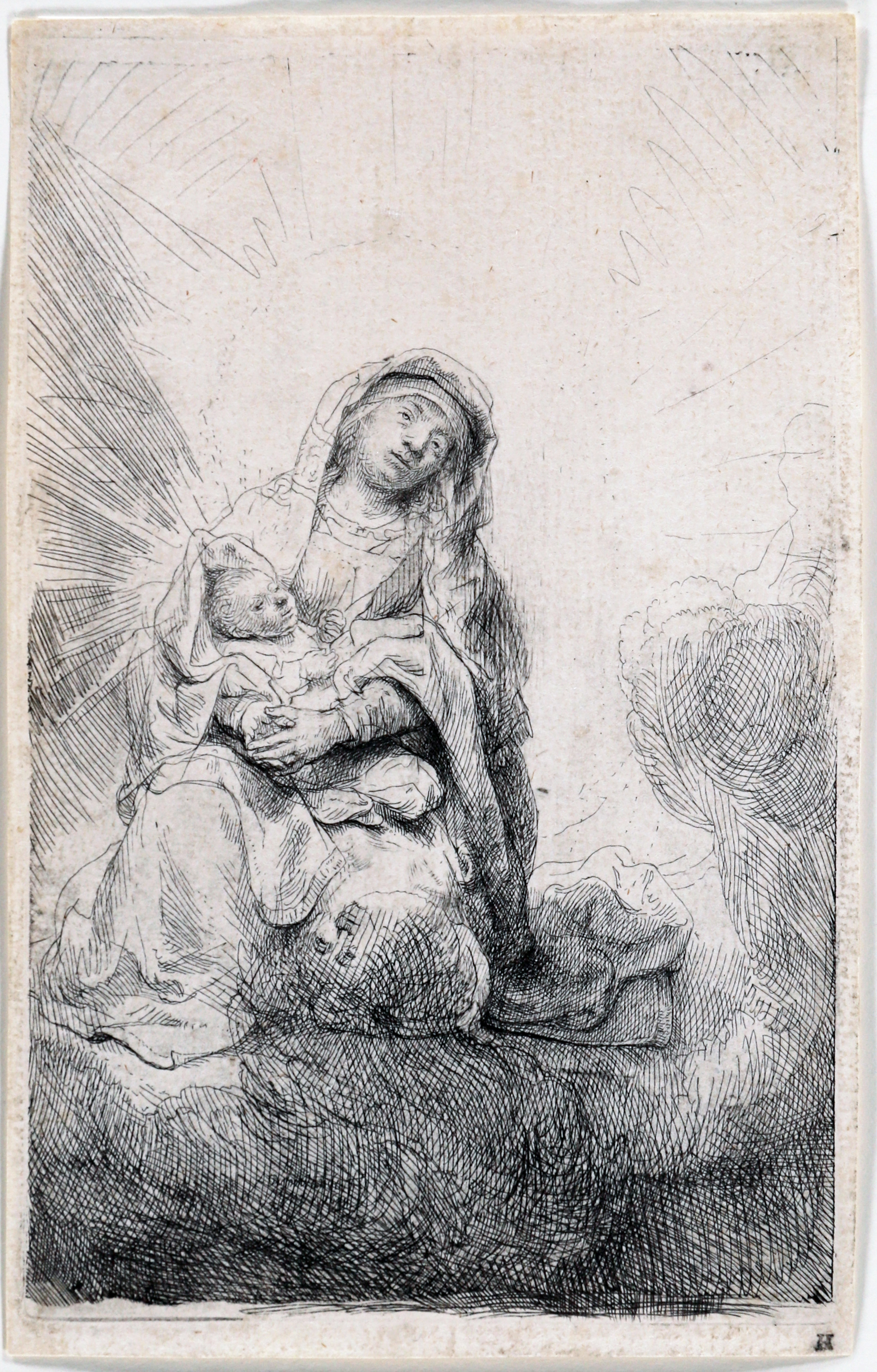
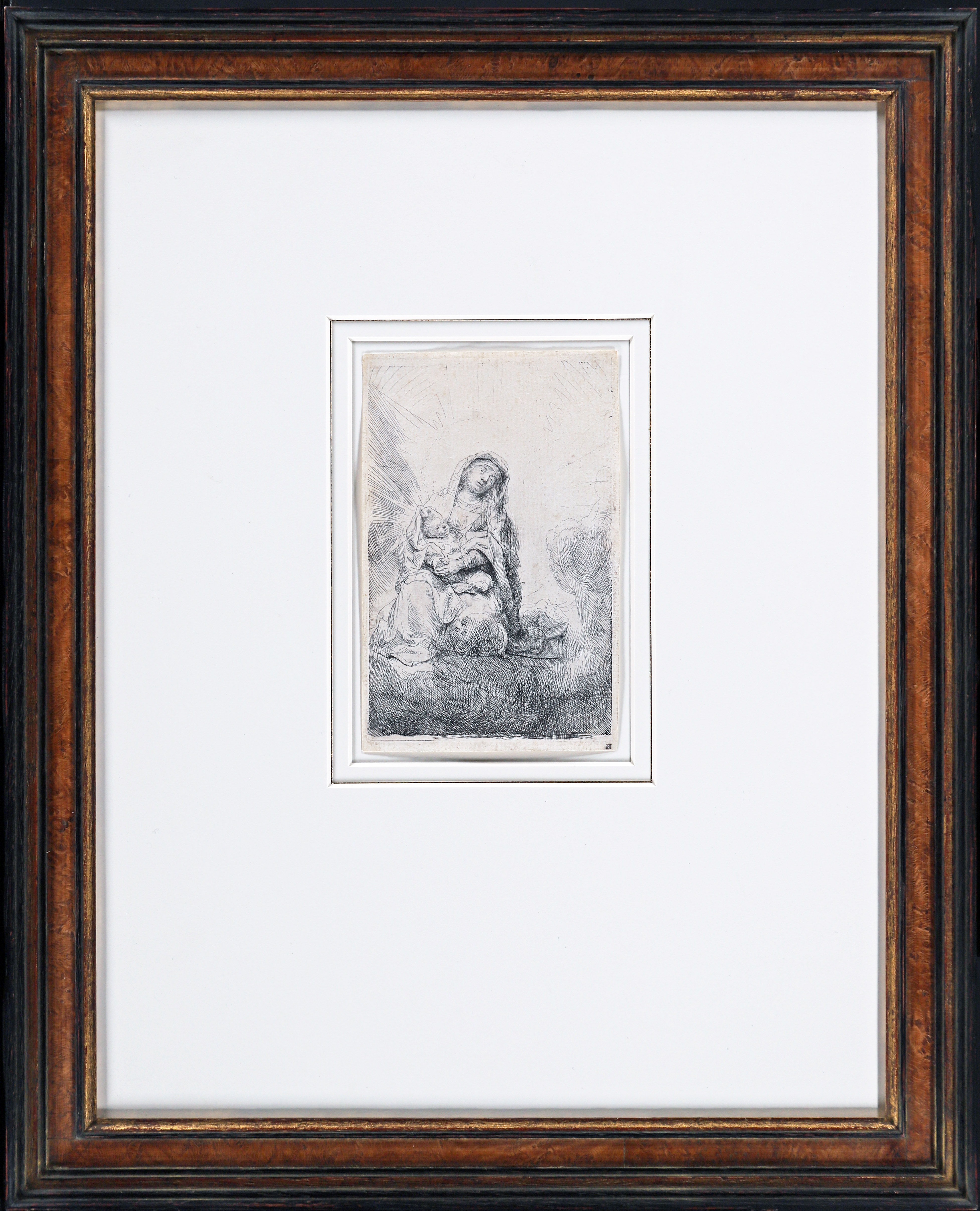
“The Virgin and Child in the clouds”, 1641
etching and drypoint on laid paper: 16,8 x 10,6 cm
signed and dated in the plate in the shadows (l.c.): Rembrandt f. / 1641
"*" indicates required fields
Notes
A very fine, early lifetime impression, printing very strongly and with great clarity; before the addition of the two dots in the upper right corner. This somewhat unusual work for Rembrandt, etched under Italian influence, was created in the year his son Titus was born. On Mary’s left knee is the manifestation of a head that is not part of the depiction. The fact that this head has not been erased indicates that Rembrandt probably did this on purpose.
This Catholic theme, rare in 17th century Dutch art, must have originated from an Italian influence such as Federico Barocci’s. The subject of ‘mother and child’ is hardly surprising to come across in the same year that Rembrandt’s only son Titus was born.
Rembrandt made a false start when he embarked on this print, and an upside-down face is visible at Mary’s left knee. Evidently the artist soon realized that the head was too small and poorly positioned in the picture plane. Without erasing the traces of his initial design, he turned the plate 180 degrees and started afresh.
Rembrandt may have drawn inspiration for the print from several sources, including Dürer’s “Madonna on the Crescent Moon” from the title page of his Life of the Virgin, a small print of the same subject by Jan van de Velde after a design by Willem Buytewech, and Federico Barocci’s “Madonna and Child,” all of which have been suggested. On closer inspection, it would not be an overstatement to describe Rembrandt’s print as a free copy after Barocci. The two are nearly the same size, and Rembrandt’s seated Virgin Mary is almost an exact repetition of them Italian master’s (albeit in reverse). It is striking that Rembrandt faithfully adopted the uncommon motif of the Virgin Mary’s folded hands. He also appears to have followed Barocci in the distribution of light and dark, and in the etching technique – with simple cross-hatching in the shaded areas. Nevertheless, the two prints are very different in tone: Barocci’s Madonna is a young, sweetly smiling girl with an idealized, symmetrical doll’s face.
The Christ child is a burly infant that gazes directly at the viewer and makes a gesture of blessing. In contrast, Rembrandt’s Virgin seems scarcely aware of the child’s presence. She stares past the viewer into the distance. His Christ is also less robust, a sickly baby that turns away from the viewer, wholly unconscious of his divinity. When set beside Barocci’s sprightly counter-reformation icon, Rembrandt’s Madonna seems laden with unfathomable emotional ambiguity. It is safe to assume that Rembrandt owned an impression of Barocci’s etching, as his 1656 inventory lists a ‘Ditto [book] with copper prints by Vanni and others including Barocci’.
During his lifetime, Rembrandt’s extraordinary skills as a printmaker were the main source of his international fame. Unlike his oil paintings, prints travelled light and were relatively cheap. For this reason, they soon became very popular with collectors not only within but also beyond the borders of the Netherlands.
Provenance
- With a collector’s mark “H” (cf. Lugt 1279, perhaps Nicholas Hazard)
- Private collection, The Netherlands
Literature
Bartsch 61; The New Hollstein no. 188: First state (of II)
Plate not in existence – with Nowell-Usticke (1967): C1+