
Rembrandt Harmensz. van Rijn
(Leiden 1606-1669 Amsterdam)
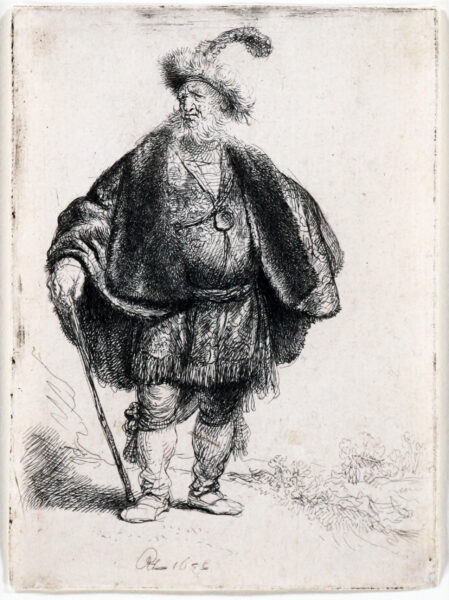
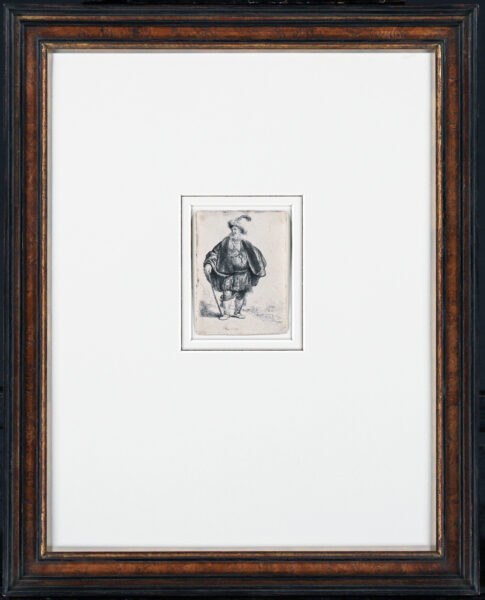
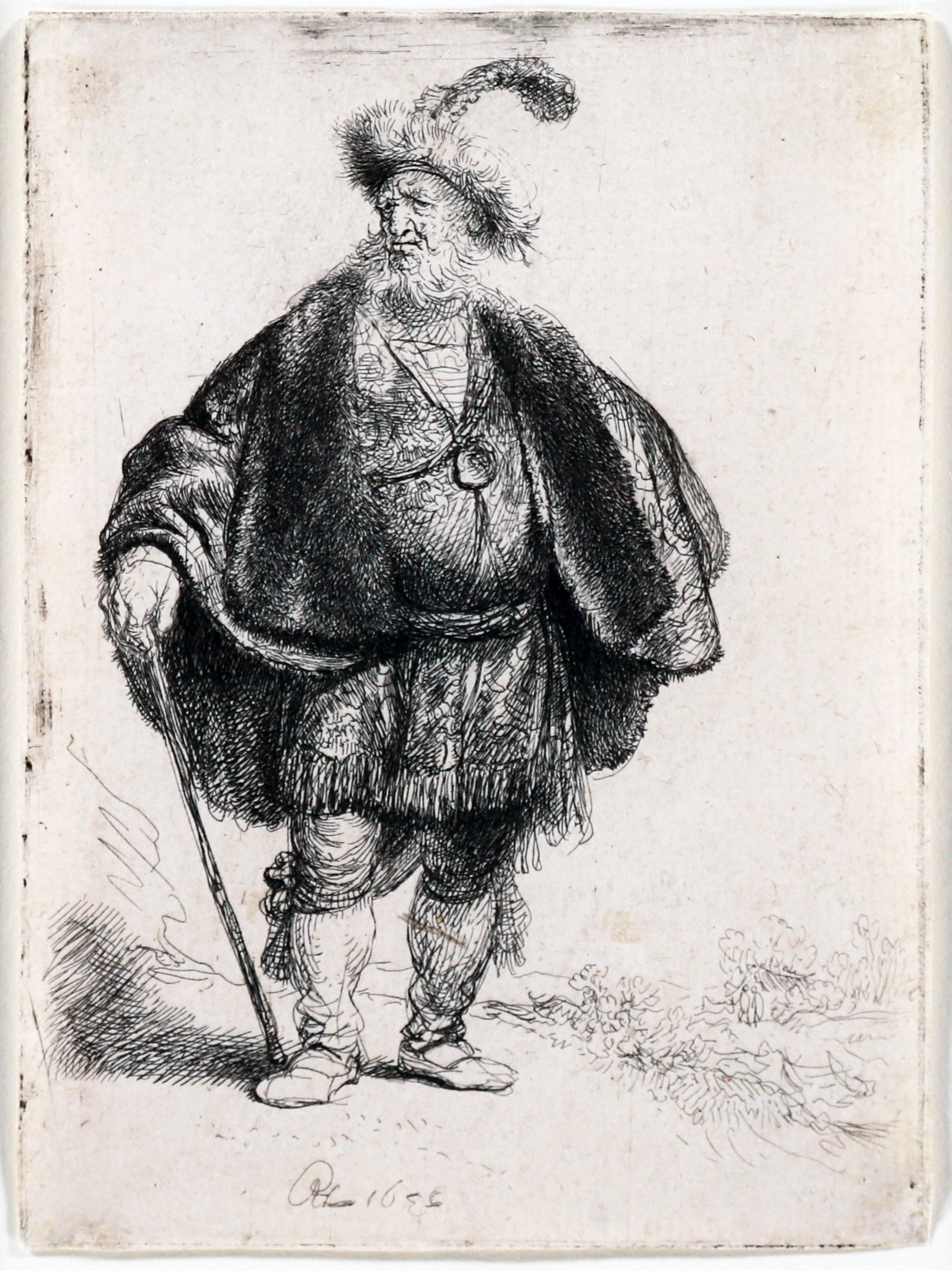
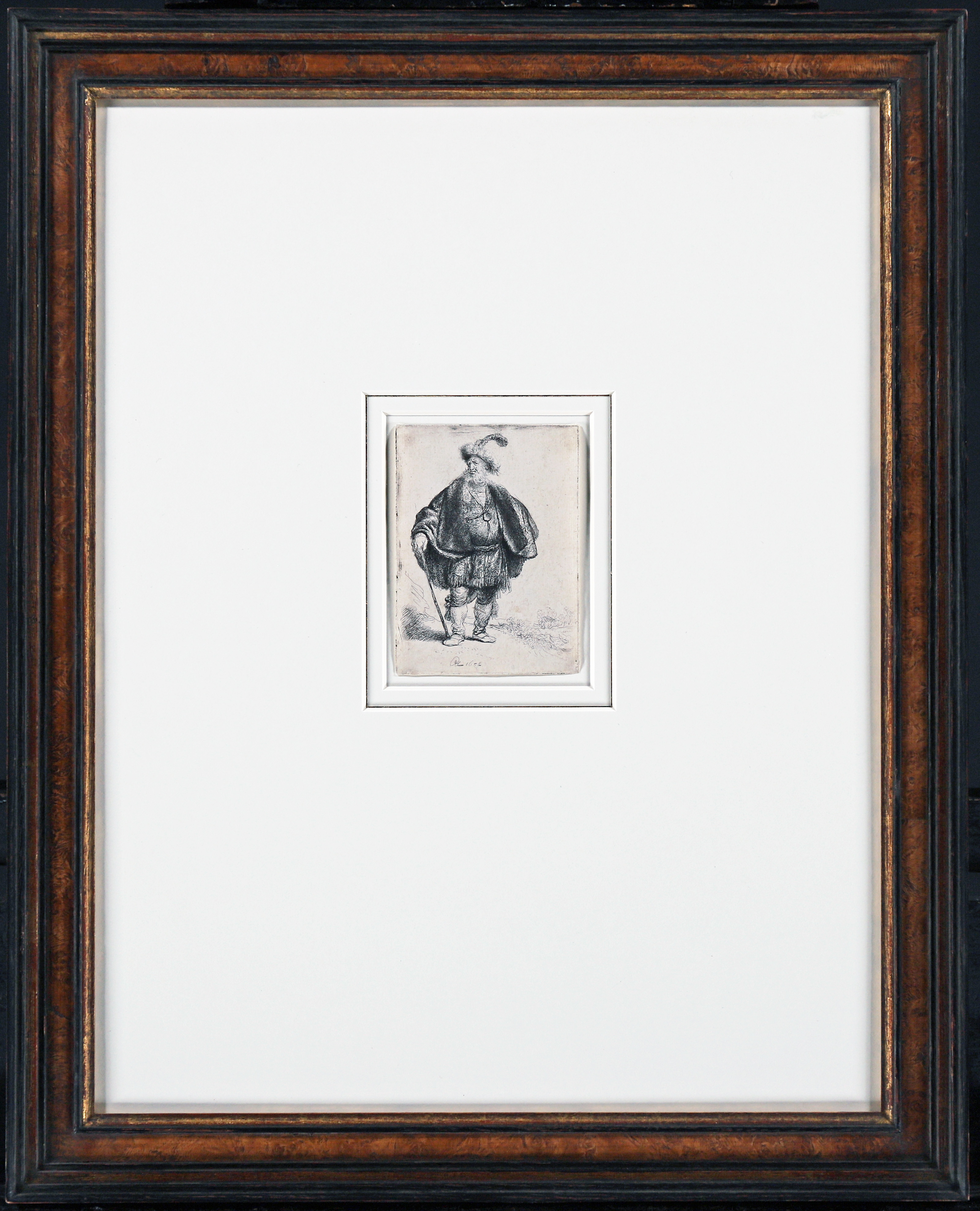
“The Persian”, 1632
etching on laid paper: 11 x 8,1 cm
signed with monogram and dated: RL 1632 (3 and 2 each reversed)
"*" indicates required fields
Notes
An early, richly tonal impression of the first state with slightly inky plate edges and a sharp corner upper right as well as horizontal scratches above the feather. Before the addition of burin strokes to strengthen the outline of the cane.
This full-length portrayal depicts a stout, bearded man in elaborate orientalising costume: a fringed tunic, fur-trimmed cloak, high boots, and a plumed fur beret, all rendered with a striking attention to texture and detail. Shown frontally, he adopts a poised stance—his right hand resting on a staff, the left akimbo—while his right foot is advanced and his gaze turns contemplatively to the left. The figure evokes the 17th-century European fascination with the exoticised East, both in fashion and physiognomy.
Already in the 18th century this print was known as ‘het Persiaantje’ (the little Persian), because the man’s clothing was perceived as having Oriental features. However, it is not genuine Iranian costume. Although Rembrandt lavished attention on rendering the fabrics, it remains an imaginary, pieced together outfit. This is actually a tronie, but then a full-length one.
This etching is held in many museums worldwide, such as the Rijksmuseum Amsterdam, the British Museum, the Metropolitan Museum of Art, the Fine Arts Museum of San Fransisco, The Morgan Library & Museum, and the Carnegie Museum of Art.
During his lifetime, Rembrandt’s extraordinary skills as a printmaker were the main source of his international fame. Unlike his oil paintings, prints travelled light and were relatively cheap. For this reason, they soon became very popular with collectors not only within but also beyond the borders of the Netherlands.
Literature
Bartsch 152; The New Hollstein no. 110: First state (of III)
Plate in existence in a private collection, USA
with Nowell-Usticke (1967): C1 – a rather uncommon print
Provenance
- Gordon W. Nowell-Usticke, his sale 31 October and 1 November 1967, Parke-Bernet Galleries, New York, lot 397;
- Sotheby’s, London, 2001
- Private collection, Germany
- Karl & Faber, Munich
- Private collection, The Netherlands