
Rembrandt Harmensz. van Rijn
(Leiden 1606-1669 Amsterdam)
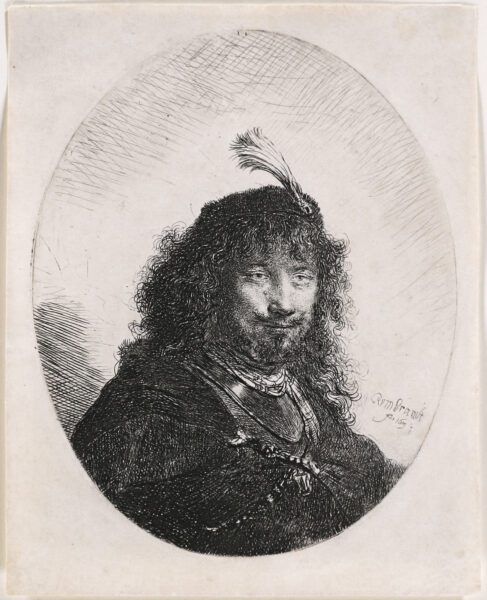
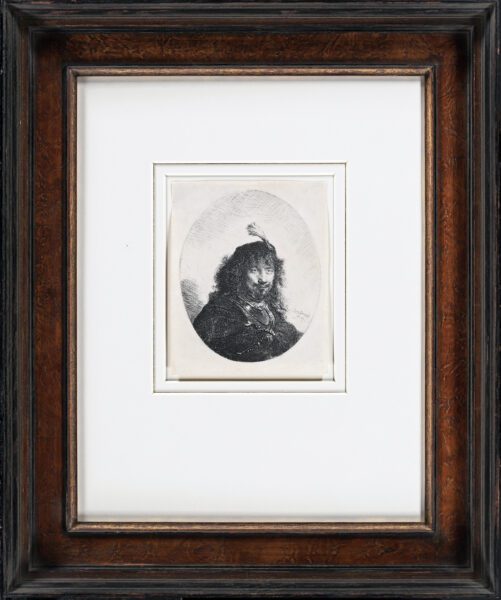
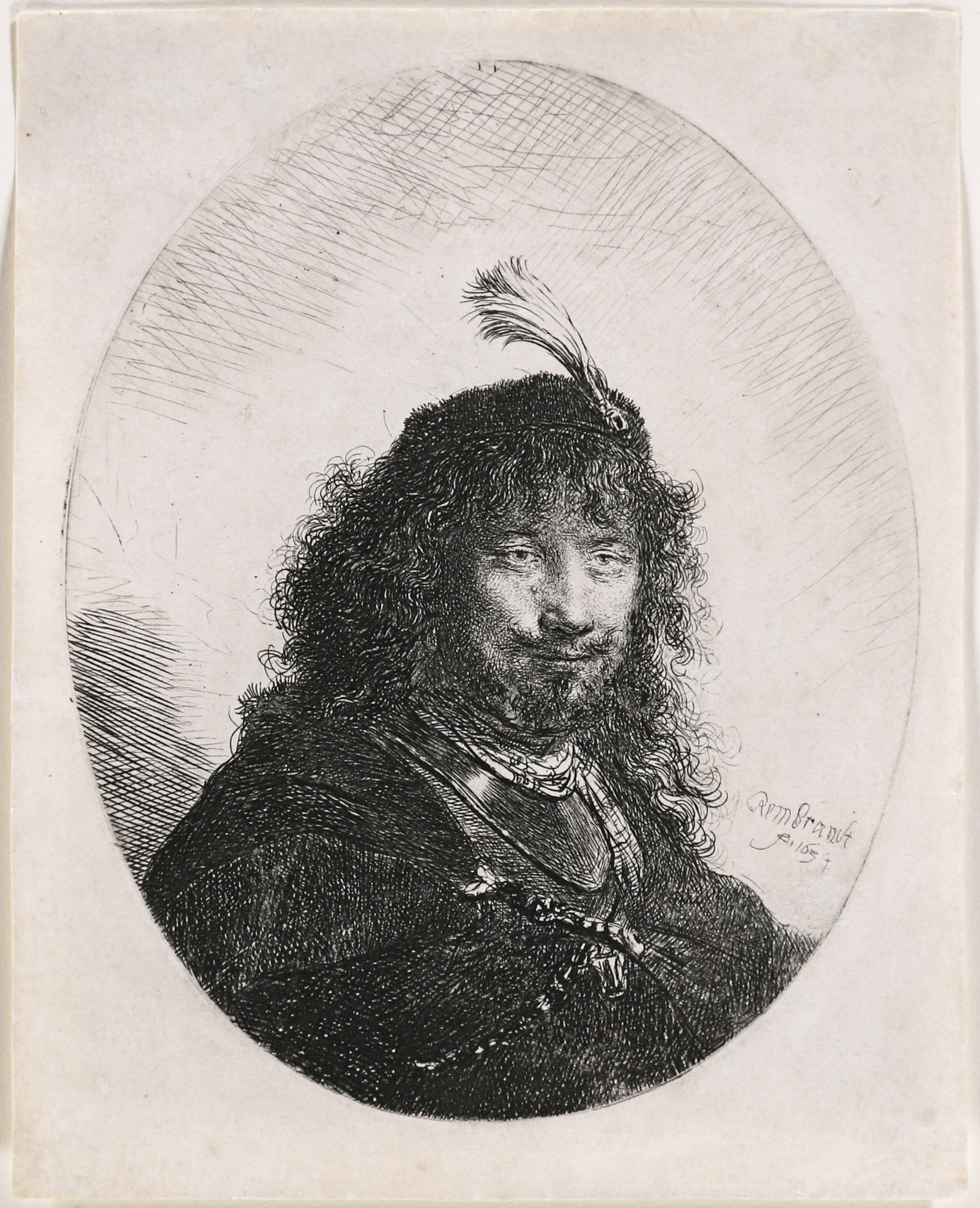
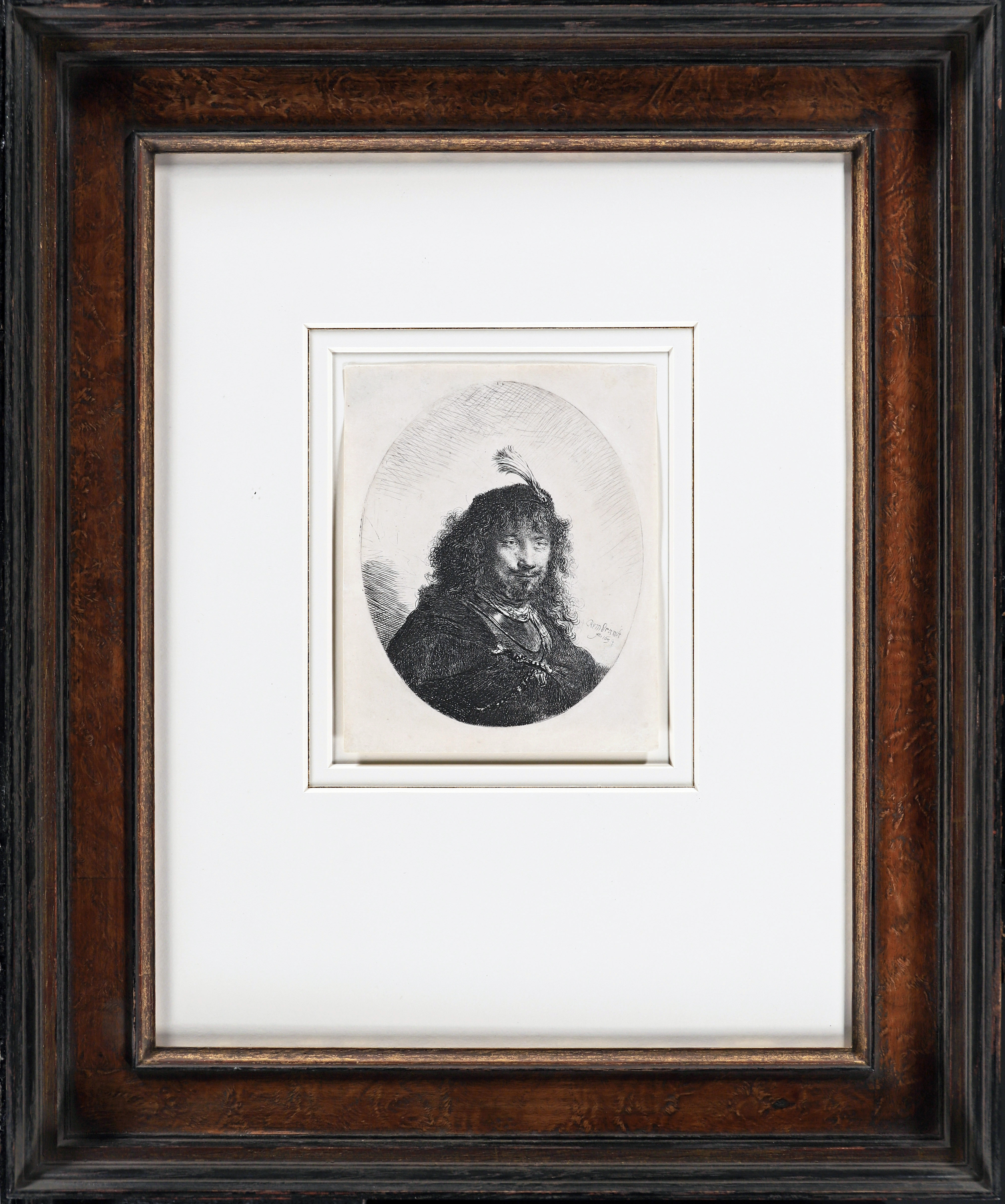
“Self-portrait (?) with plumed cap and lowered sabre”, 1634
etching and engraving on laid paper: 14,7 x 11,8 cm
signed and dated lower right: Rembrandt | f. 1634
"*" indicates required fields
Notes
A fine early impression with the delicate scratches to the right of the signature still visible. Rare, the plate has not been preserved, there are no late prints. With wide margins and very rare.
Throughout his career, Rembrandt engaged extensively with the genre of self-portraiture, producing a substantial body of work in which he frequently employed a mirror as a compositional aid. These portraits, highly prized by contemporary collectors, attest not only to his enduring interest in self-representation but also to his investigation of the expressive capacities of the human face. On numerous occasions, Rembrandt utilised his own likeness as a vehicle for the study of emotional states, including fear, anger, and contemplation. In the present work, he adopts an orientalist guise, donning attire evocative of figures from the Old Testament. This choice of costume reflects both his engagement with biblical narrative traditions and the broader seventeenth-century European fascination with the exotic—a construct shaped by cultural exchange, colonial expansion, and the visual imagination of the time. Such “exotic” items could have been brought to Holland from Asia in the 1630s by the Dutch East India Company.
Rembrandt made more than ninety self-portraits throughout his life, using his visage to project different personae—soldier, prince, scholar—all mirroring the human condition. He wanted to make his face as known as the single name Rembrandt, which was the way he began to sign his work after 1633.
Rembrandt experimented with the etching process to achieve a remarkable range of tonal and linear effects, often reworking and printing his compositions in various versions, or states. The first state of this image was a three-quarter portrait that included a lowered sabre in the figure’s hand. For the second and third state, Rembrandt reduced the image to an oval focused on the face and upper torso.
During his lifetime, Rembrandt’s extraordinary skills as a printmaker were the main source of his international fame. Unlike his oil paintings, prints travelled light and were relatively cheap. For this reason, they soon became very popular with collectors not only within but also beyond the borders of the Netherlands.
Literature
Bartsch 23; The New Hollstein no. 135: Third state (of III)
Plate not in existence – with Nowell-Usticke (1967): C1
Provenance
- Sir Edward Astley (1729-1802), Norfolk, with the collector’s stamp verso
(Lugt 2775); - William Sharp (19th Century), Manchester initials in brown ink verso (Lugt 2650);
- Old Gersaint number in pen in bottom right corner.
- Private collection, Germany
- Karl & Faber, Munich
- Private collection, The Netherlands