
Rembrandt Harmensz. van Rijn
(Leiden 1606 - 1669 Amsterdam)
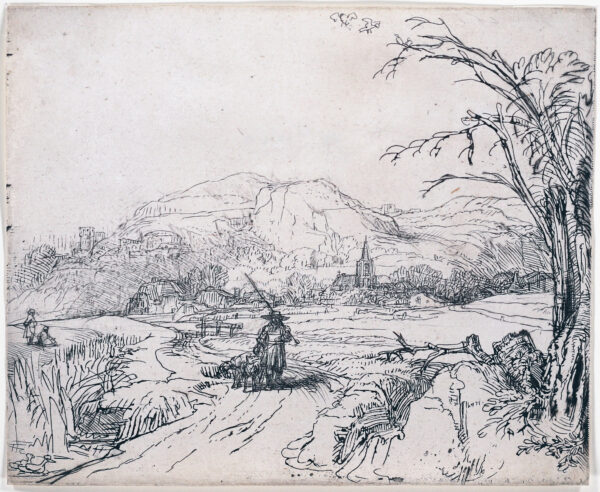
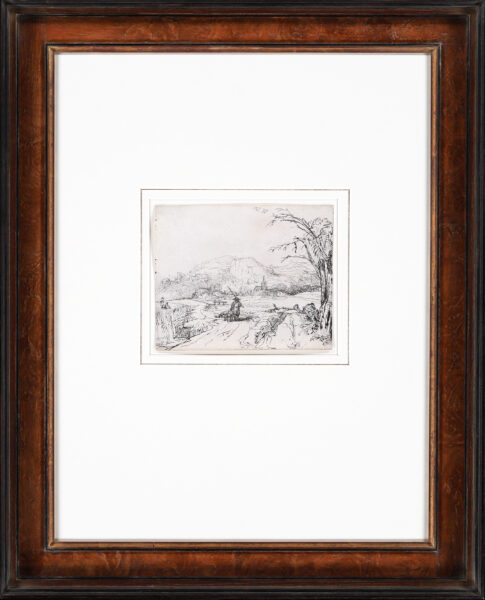
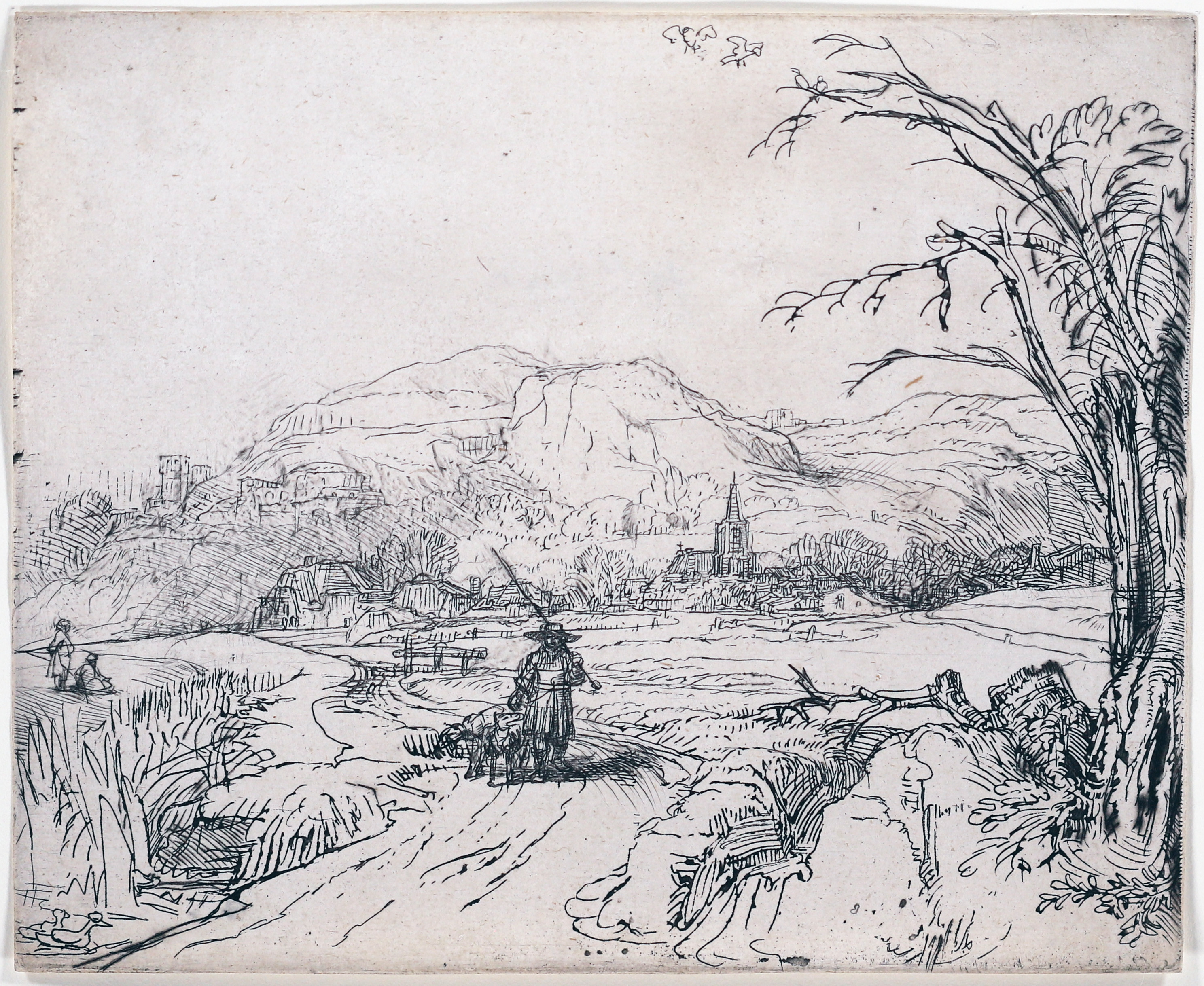
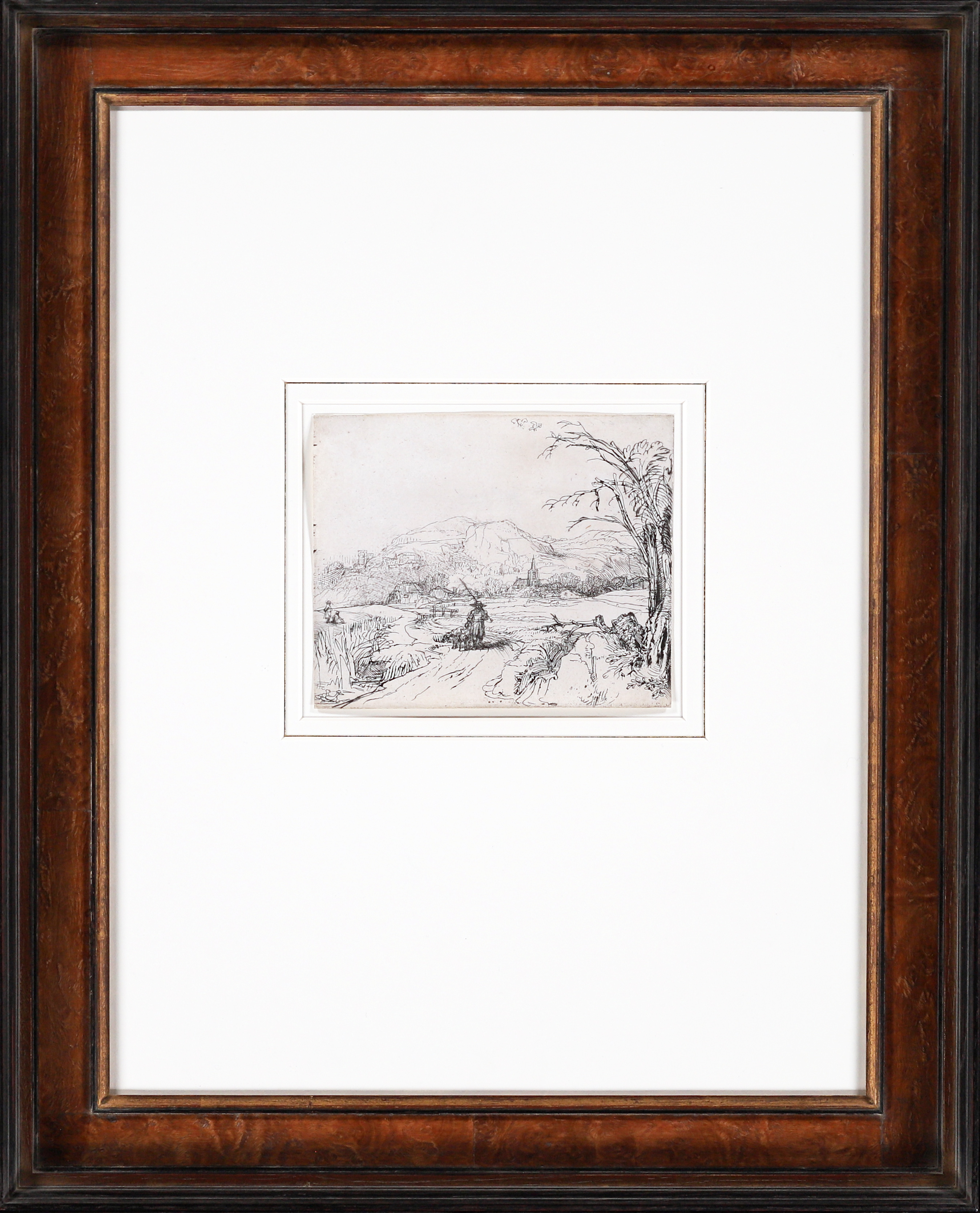
“Landscape with sportsman and dogs (‘Het Jagertje’)”, c. 1648
Etching with drypoint: 13 x 15,8 cm
"*" indicates required fields
Notes
During his lifetime, Rembrandt’s extraordinary skills as a printmaker were the main source of his international fame. Unlike his oil paintings, prints travelled light and were relatively cheap. For this reason, they soon became very popular with collectors not only within, but also beyond the borders of the Netherlands.
A very fine and crisp lifetime impression of the second state, exhibiting strong burr particularly in the tree on the right and along the side edges. The farm and hay barn behind the standing and seated figures to the left, as well as the wooden fence just left of the sportsman’s head, have now been burnished out.
Prints of this subject are rare, as the plate was lost early on. In Nowell-Usticke, it is marked with an ‘R’ for ‘rare’ and described as ‘a scarce plate’.
In this finely executed etching, a wide Dutch landscape unfolds, traversed by a canal running alongside a road that leads towards a village with a church spire at its centre. The composition is framed on the right by a copse in the foreground, while on the left, two seated figures can be seen in a meadow. Two ducks glide along the canal, a quiet detail that enhances the scene’s pastoral serenity.
In the middle ground, a sportsman accompanied by two dogs appears, a motif that gives the print its traditional title Het jagertje (‘The Little Hunter’). Beyond him, gentle hills rise, dotted with scattered buildings along their slopes.
In this second state of the print; a previously visible farmhouse and barn above the two seated figures on the left have been carefully burnished out; an alteration that reflects Rembrandt’s deliberate approach to composition.
The etching demonstrates his masterful use of light and line to create a rich atmospheric effect.
Literature
Bartsch 211; White/Boon 211;
The New Hollstein Dutch 245 Secoind state of (II)
Plate not in existence – with Nowell-Usticke (1967): R – A scarce print
Provenance
- Sir Thomas Lawrence (1769-1830), Bristol, bottom right with faint impression of the collector’s stamp (Lugt 2446);
- Galerie Gerda Bassenge, Berlin, 2006
- Private collection, Germany
- Karl & Faber, Munich
- Private Collection, The Netherlands