
Rembrandt Harmensz. van Rijn
(Leiden 1606 - 1669 Amsterdam)
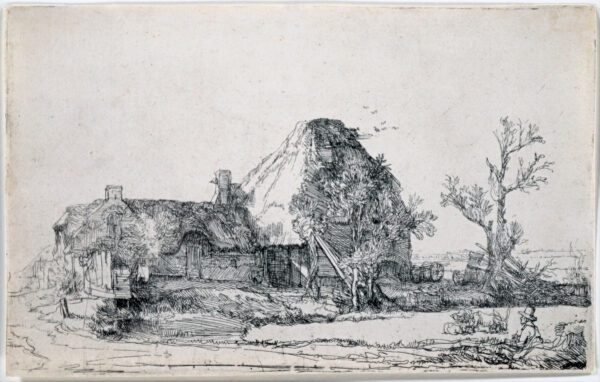
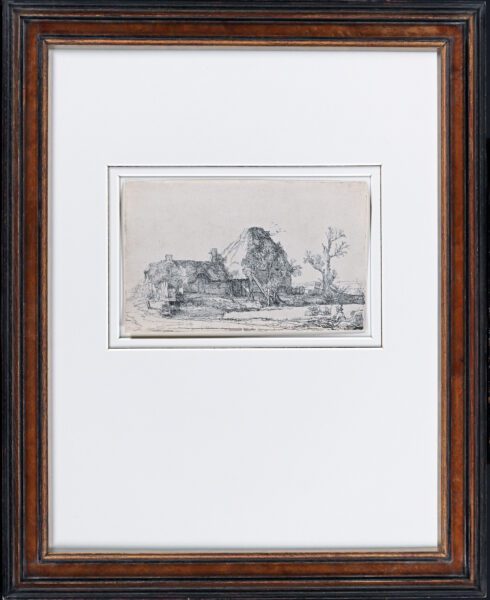
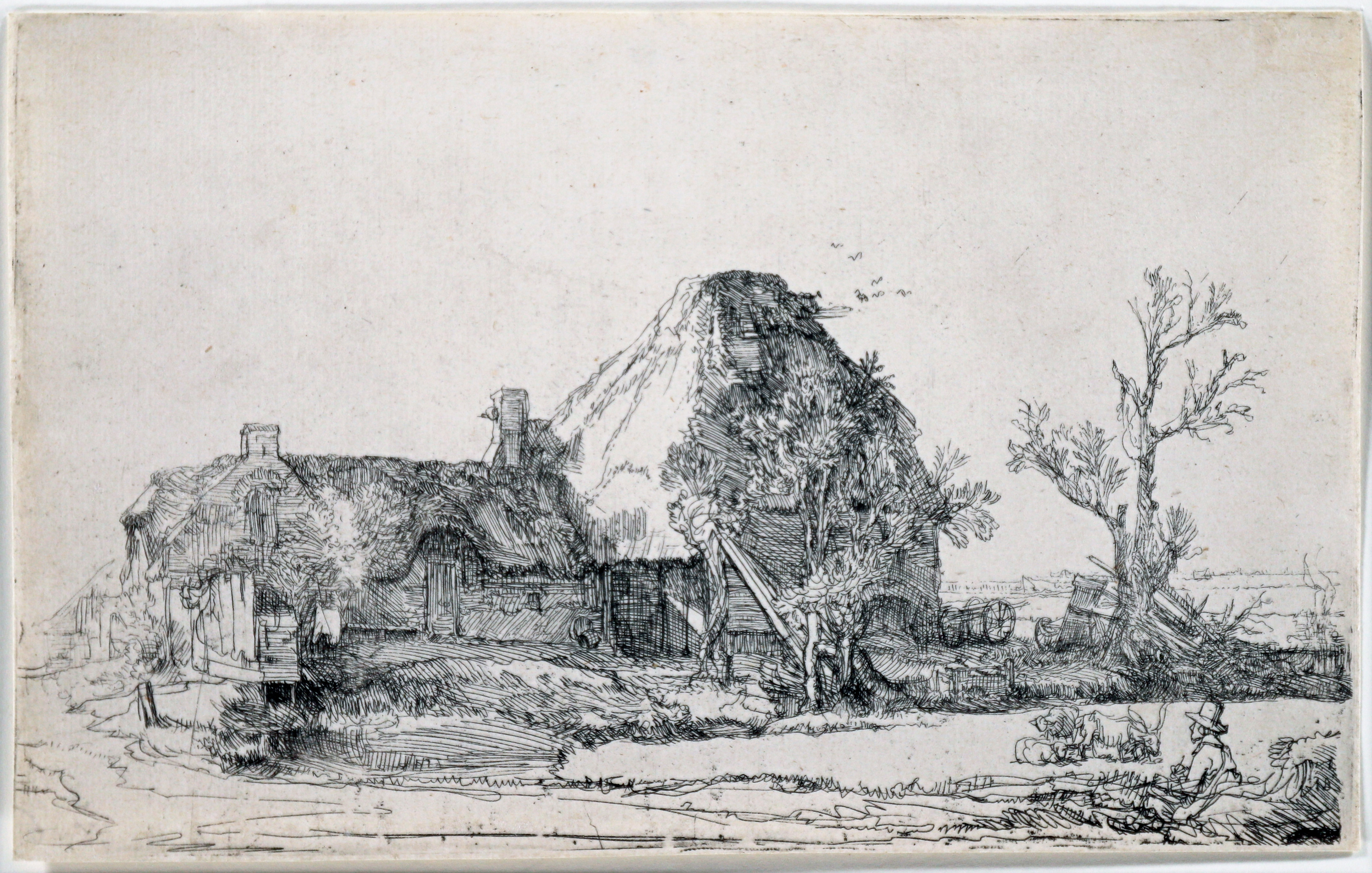
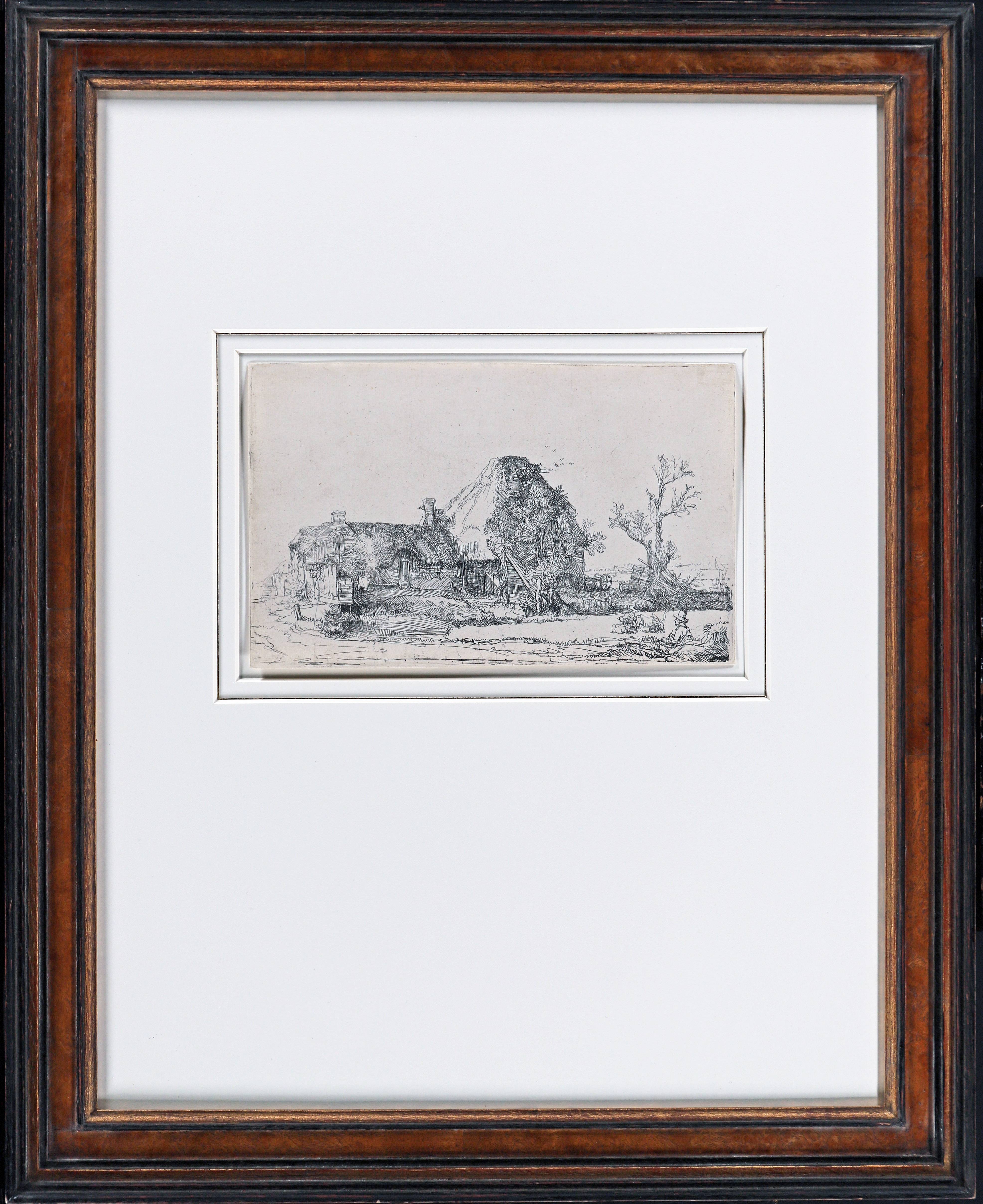
“Cottage and farm buildings with a man sketching”, c. 1645
Etching on laid paper: 13,2 x 21,2 cm
Watermark: countermark LB (Hinterding A.a)
with narrow margins
"*" indicates required fields
Notes
During his lifetime, Rembrandt’s extraordinary skills as a printmaker were the main source of his international fame. Unlike his oil paintings, prints travelled light and were relatively cheap. For this reason, they soon became very popular with collectors not only within, but also beyond the borders of the Netherlands.
A humble, rather dilapidated farmhouse is a subject that recurs in many of Rembrandt’s landscape etchings. The level of detail implies that he, like the artist shown drawing in the foreground at right, had oftentimes sketched such places en plein air. Whilst the little figure of the draughtsman is a reflection figure rather than a self-portrait- the artist depicted here has a beard – Rembrandt has adopted a very similar low viewpoint as him. Whether or not Rembrandt actually drew this plate from life and in situ – the result is full of charming, incidental detail and the print is one the most cheerful and light-hearted of all his landscapes.
The draughtsman is drawing a traditional Dutch ‘stolpboerderij’ or Haubarg-type farmhouse, many of which could be found around Amsterdam. It is constructed of bricks, a very costly material at the time and may have been built to produce butter, with the cellar and the ‘opkamer’, or upstairs room, for storage. You can just imagine Rembrandt sitting in the grass like this. The view into the otherwise flat landscape is blocked by a tree next to the house. The ship’s sails in the background indicate a river, possibly the Amstel.
In New Hollstein (2013) Hinterding and Rutgers date this print to circa 1641, but this appears to be a mistake and is not in keeping with the paper evidence as presented by Hinterding himself in the catalogue of Rembrandt’s watermarks (2006), which suggest a first printing date of circa 1645.
Prints are very rare, the plate was lost early and there are no late impressions.
Literature
Bartsch 219; The New Hollstein Dutch 201 (this impression cited): First and only state.
Provenance
- Probably Johan Fredrik Martin (1755-1816) and Elias Martin (1739-1818), Stockholm (without oval, see Lugt 3846).
- Indistinct Letters, possibly initials DD in pencil verso (Daniel Daulby, see Lugt 738; not in his sales).
- Nathaniel Smith (1740⁄41- circa 1809), London (see Lugt 2296; variously inscribed in pen and brown ink verso, including with the code DIXXF).
- Sotheby’s, London, 2 May 1927, lot 3 (‘The Property of a Nobleman’; to Colnaghi).
- With P. & D. Colnaghi & Co., London (with their stocknumber C 16015 in pencil verso).
- Probably Lady Ethel Edith Bilsland (1892-1982), London (not in Lugt; according to Stogdon); presumably acquired from the above.
- With P. & D. Colnaghi & Co., London (with their stocknumber C 38107 in pencil verso); acquired from the above in 1971.
- Sam Josefowitz (Lugt 6094); acquired from the above in 1972;
- thence by descent.
- Private collection, The Netherlands
A fine impression of this uncommon landscape. Printing sharply, clearly and with good contrasts with fine, vertical wiping marks in the sky; the subtle plate tone more prominent toward the edges.