
Rembrandt Harmensz. van Rijn
(Leiden 1606-1669 Amsterdam)
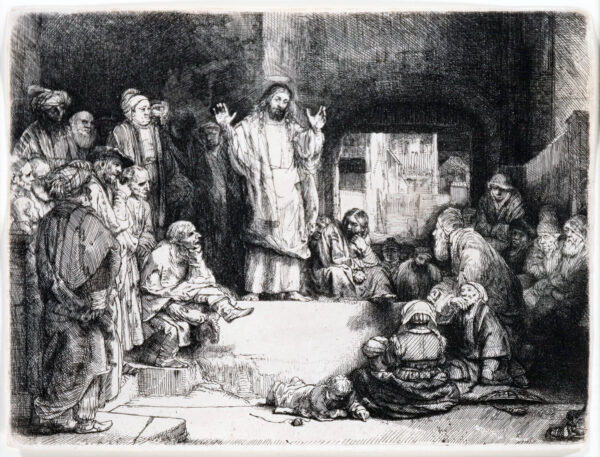
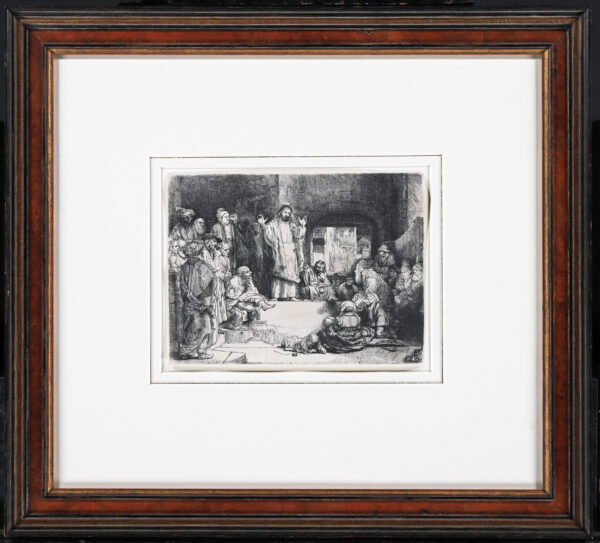
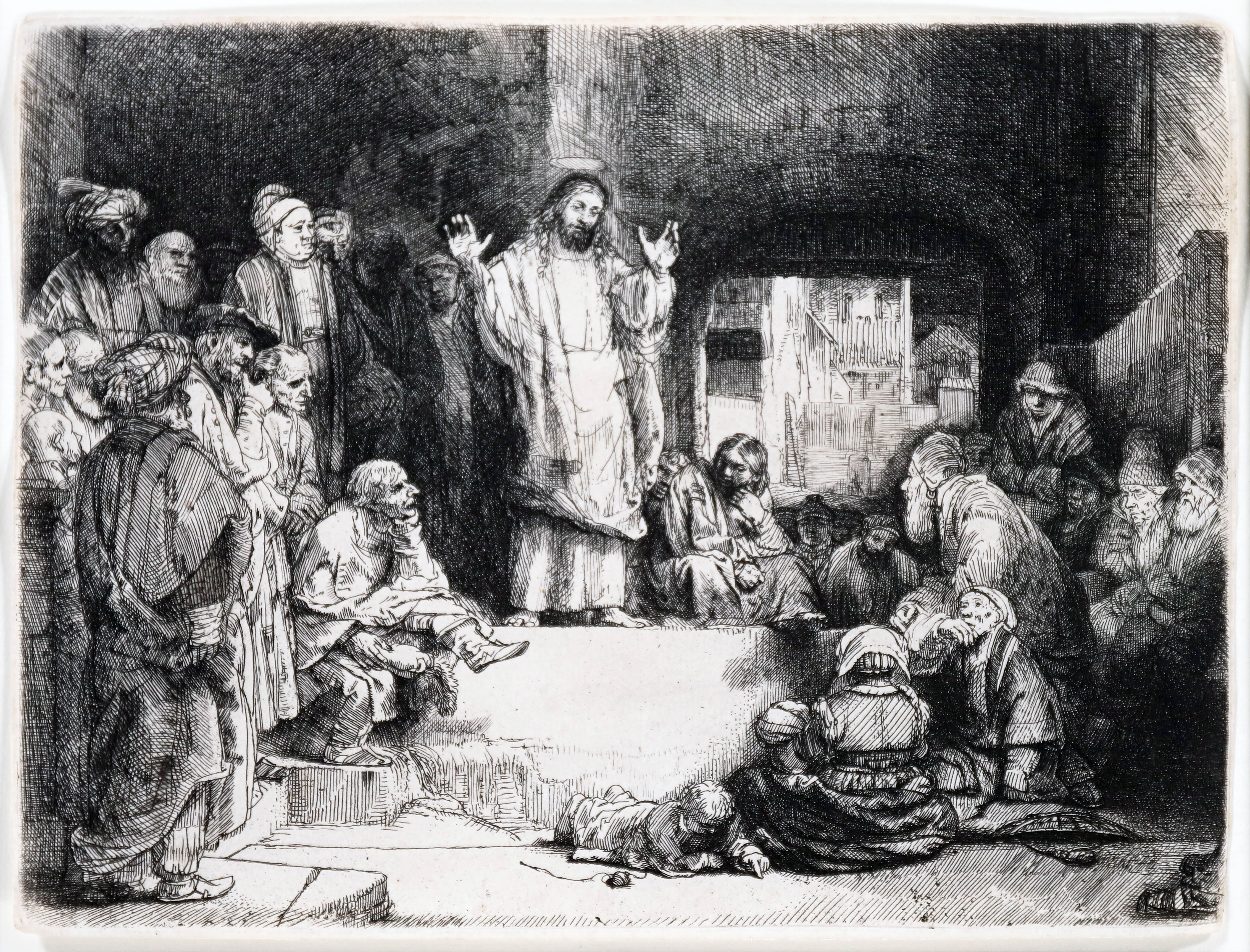
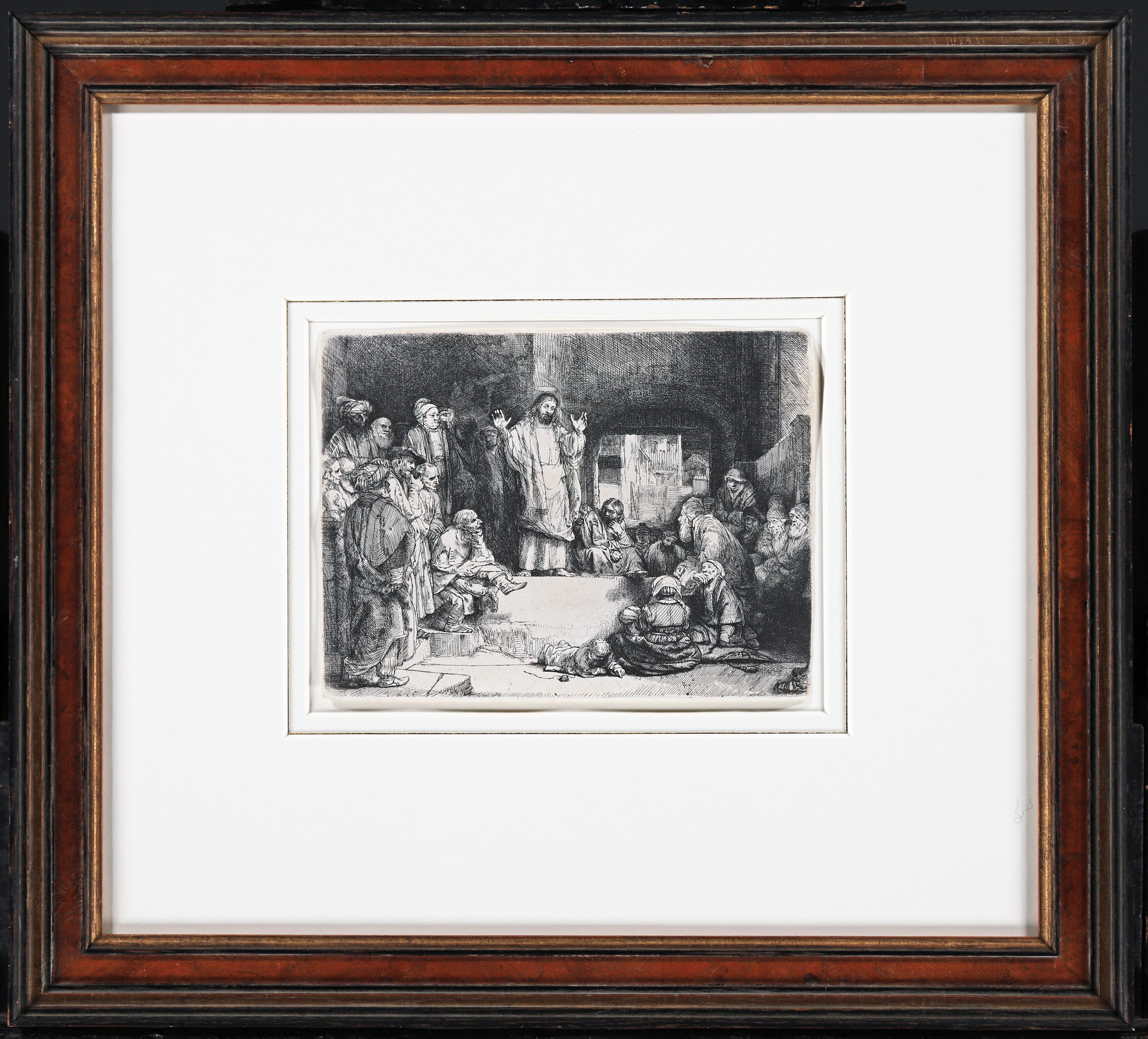
“Christ Preaching (‘La Petite Tombe’)”, 1657
etching and drypoint on laid paper: 15,4 x 20,5 cm
"*" indicates required fields
Notes
Christ preaching or ‘La Petite Tombe’ is the smallest and last of Rembrandt’s great, multi-figure compositions of scenes from the Life of Christ. It was created about eight years after the famous Christ healing the Sick (‘The Hundred Guilder Print’) and just after Rembrandt had completed work on his two most radical and ambitious endeavours in printmaking, Christ crucified between the two Thieves: ‘The Three Crosses’ and Christ presented to the People (‘Ecce Homo’). We can only speculate why Rembrandt, at this point in his career, decided to make a print of a similarly important subject, Christ preaching, on a more modest scale. Perhaps he was disheartened by the effort his two monumental drypoints – The Three Crosses and Ecce Homo – had required to create and print, and disappointed by the financial gains they had brought. It may have felt reasonable and commercially viable to apply his recent experiences and lessons learned to a more manageable project: a smaller plate, without the need for extra-large and expensive sheets of paper or vellum – and with drypoint, but without relying entirely on it and having to cope with its transience.
There may have been another, very practical instigation for the creation of this print: it could have been a commission. The etching’s nickname La Petite Tombe derives from the description of the plate in Clement de Jonghe’s estate inventory. This title was then adopted by Gersaint in his first methodical catalogue of Rembrandt’s prints of 1751, and has stuck ever since. This is clearly a misunderstanding, for the print does not depict a ‘little tomb’. The description in de Jonghe’s inventory was probably an abbreviation of ‘La Tombe’s small print’ and thus referred to the either Nicolaes or Pieter de la Tombe, who both had relations with Rembrandt. It seems likely that one or the other de la Tombe had owned or commissioned the plate.
Whatever the circumstances of its conception, Christ preaching is more finished and unified, more controlled and balanced than the aforementioned, larger prints. The figure of Christ is imposing enough and his listeners numerous, yet the whole scene feels intimate and engaging. Rembrandt achieved this by setting it within a confined space, yet giving it depth by allowing a distant view through the gateway. By arranging the crowd in an almost complete circle, only leaving a gap in the front, the viewer becomes part of Christ’s audience. This sense of proximity and immediacy is further heightened by the care with which Rembrandt has depicted the individual figures. Some, in particular the man seated on the left and the older one directly behind him, have the veracity of true portraits. The child lying in the foreground, oblivious to the words of Jesus, is an endearing detail, but also an artistic device: it adds an element of ‘real life’ to the event and brings it into the here and now. It is furthermore a self-referential allusion to the myth of artistic genius: the gifted child, inexorably drawing in the sand.
Early impressions show heavy burr, causing, among others, the right sleeve of the man in the turban in the left foreground to appear black (‘het zwarte mouwtje’ or ‘The black sleeve’). This effect gradually wears away (‘het witte mouwtje’ or ‘The white sleeve’), like in this current etching.
This etching is held in many museums worldwide, such as the Rijksmuseum Amsterdam, the British Museum, the Metropolitan Museum of Art, the Fine Arts Museum of San Fransisco, The Morgan Library & Museum, and the Carnegie Museum of Art.
During his lifetime, Rembrandt’s extraordinary skills as a printmaker were the main source of his international fame. Unlike his oil paintings, prints travelled light and were relatively cheap. For this reason, they soon became very popular with collectors not only within but also beyond the borders of the Netherlands.
Literature
Bartsch 67; The New Hollstein no. 298: First state (‘Het witte mouwtje’) (of II)
Plate last seen at Colnaghi, London 1830. Perhaps still in existence.
with Nowell-Usticke (1967): C2 – fine impressions much desired
Provenance
- Private collection, The Netherlands