
Rembrandt Harmensz. van Rijn
(Leiden 1606 - 1669 Amsterdam)
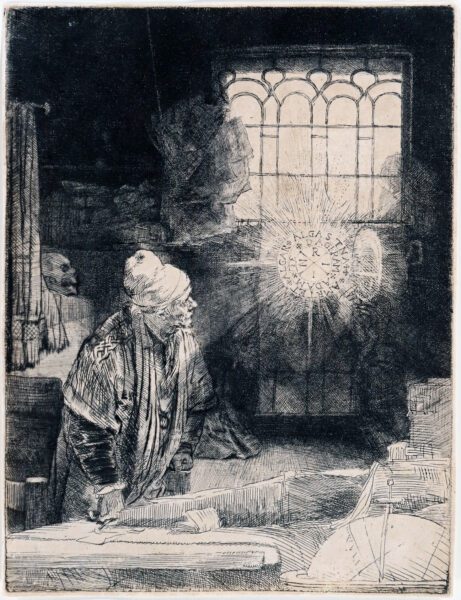
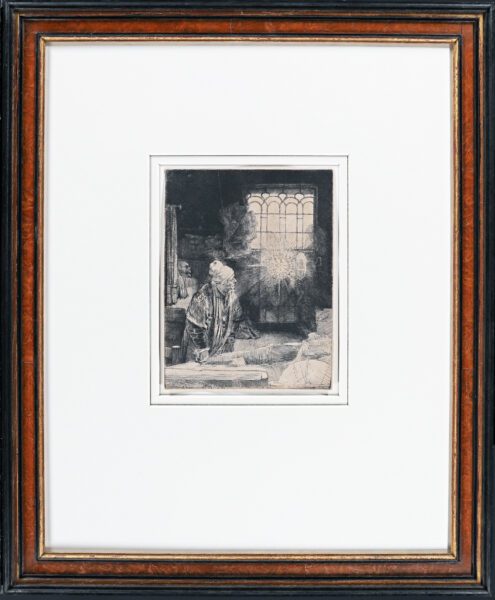
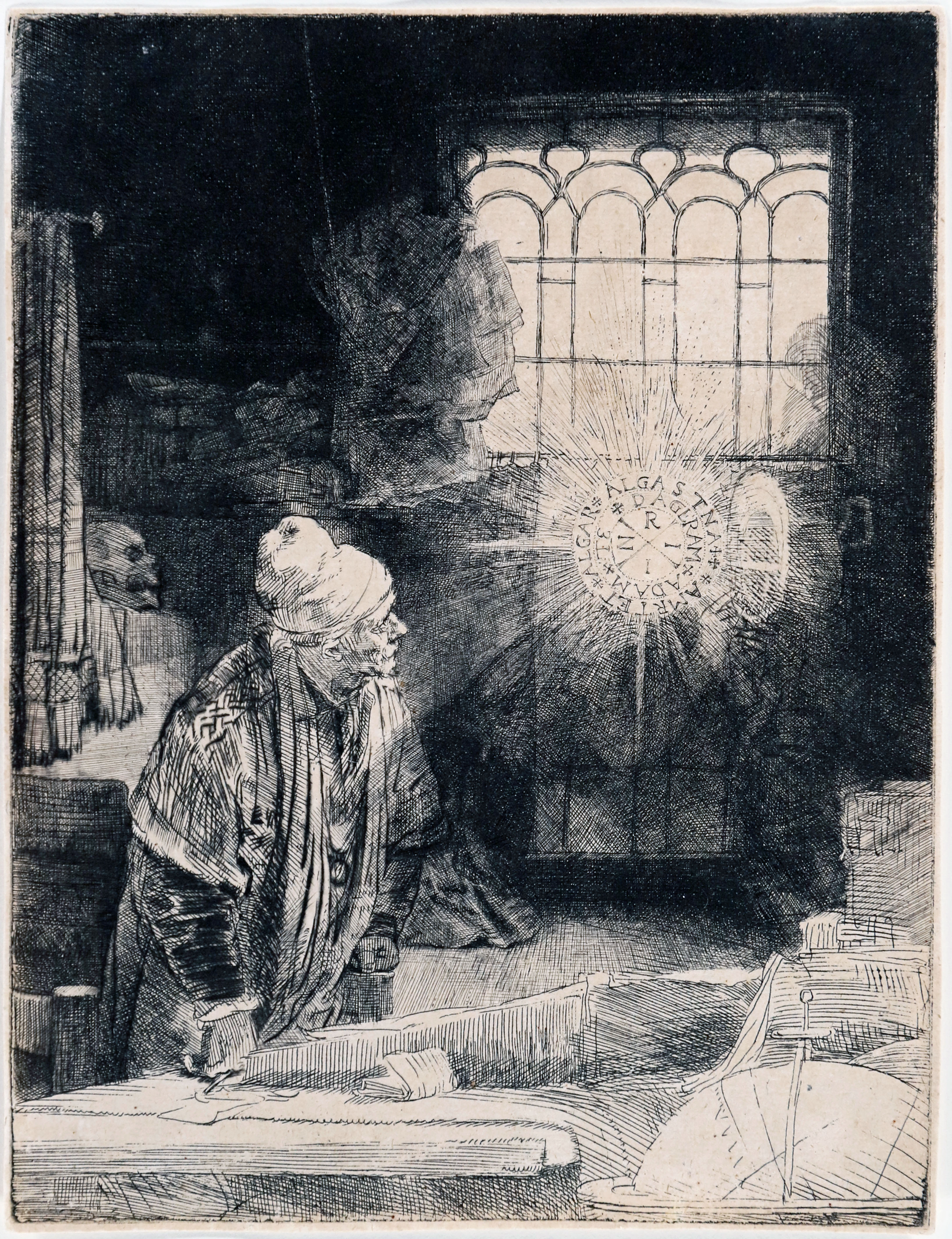
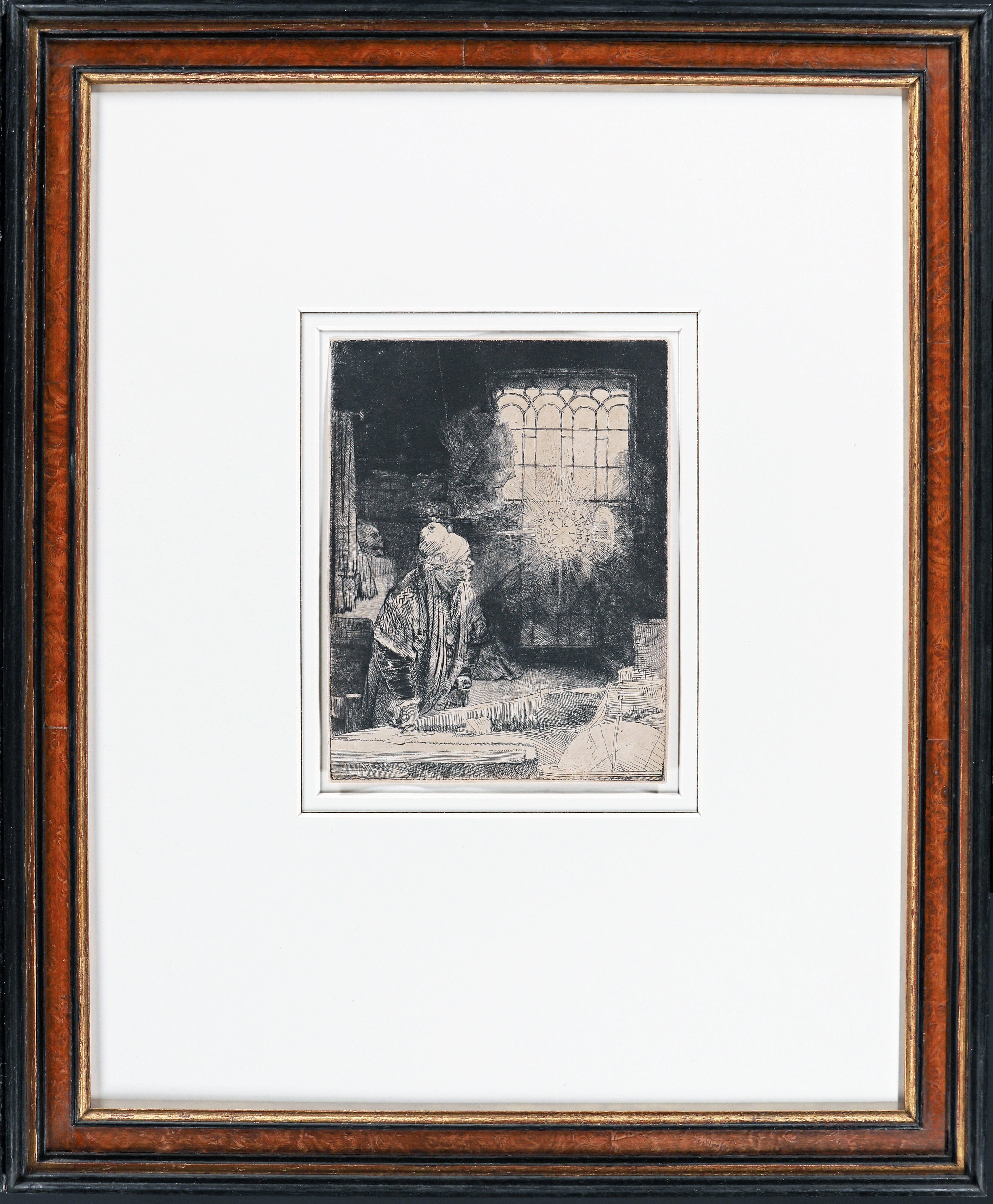
“A Scholar in his study (‘Faust’)”, c. 1652
Etching with drypoint and burin
on soft oatmeal paper: 21,4 x 16,3 cm
"*" indicates required fields
Notes
During his lifetime, Rembrandt’s extraordinary skills as a printmaker were the main source of his international fame. Unlike his oil paintings, prints travelled light and were relatively cheap. For this reason, they soon became very popular with collectors not only within, but also beyond the borders of the Netherlands.
An extremely fine, lifetime impression, printed on coarse-fibred, soft oatmeal paper, with strong burr on the curtain, the skull and on the coat of the scholar. With fine margins.
This impression offers a compelling example of Rembrandt’s nuanced handling of plate tone and surface wiping. Through selective wiping, he carefully exposed key elements such as the books and manuscripts on the shelves at upper left, as well as the modelling of Faust’s garment. Simultaneously, he preserved the rich burr in the densely etched areas of the curtain and its fringes, thereby achieving a striking balance between linear precision and atmospheric density.
An impression on similar oatmeal paper is held in the Albertina, Vienna, and is reproduced life-size in Rembrandt: The Late Works, p. 156. By contrast, earlier impressions printed on Japanese and European laid papers exhibit a markedly different character. In those, Rembrandt applied the ink more generously and wiped the plate only lightly, allowing heavy plate tone and burr to obscure finer details. As a result, the middle ground—particularly Faust’s shoulder and cloak—becomes enveloped in a richly textured shadow, lending the composition a markedly painterly quality.
Rembrandt’s choice of oatmeal paper—used for only a select number of impressions—is significant. Its lightly fibrous texture and soft buff hue contribute to the evocation of Faust’s dimly lit, dust-filled study. This particular paper not only amplifies the atmospheric effect but also serves as a deliberate aesthetic decision within the broader strategy of the print. The combined use of selective wiping, controlled burr, and an optically responsive support underscores Rembrandt’s sophisticated understanding of how material and technique can be orchestrated to heighten expressive content.
(See Nancy Ash and Shelley Fletcher, ‘Rembrandt the Printmaker: Materials and Techniques’, in: Erik Hinterding et al. (eds), Rembrandt the Printmaker, London: British Museum Press, 2000, pp. 53–65; and Erik Hinterding, Rembrandt as an Etcher: The Practice of Production and Distribution, vol. 1, Ouderkerk aan de Amstel, 2006, pp. 111–145.)
Provenance
- Müller-Jabusch, verso with the collector’s stamp (not in Lugt).
- Private collection, Germany
- Karl & Faber, Munich
- Private Collection, The Netherlands
Literature
Bartsch 270; The New Hollstein Dutch 270: First state of (VII)
Plate in existence at Douwes Fine Art, Amsterdam
with Nowell-Usticke (1967): Early states much wanted and very rare