
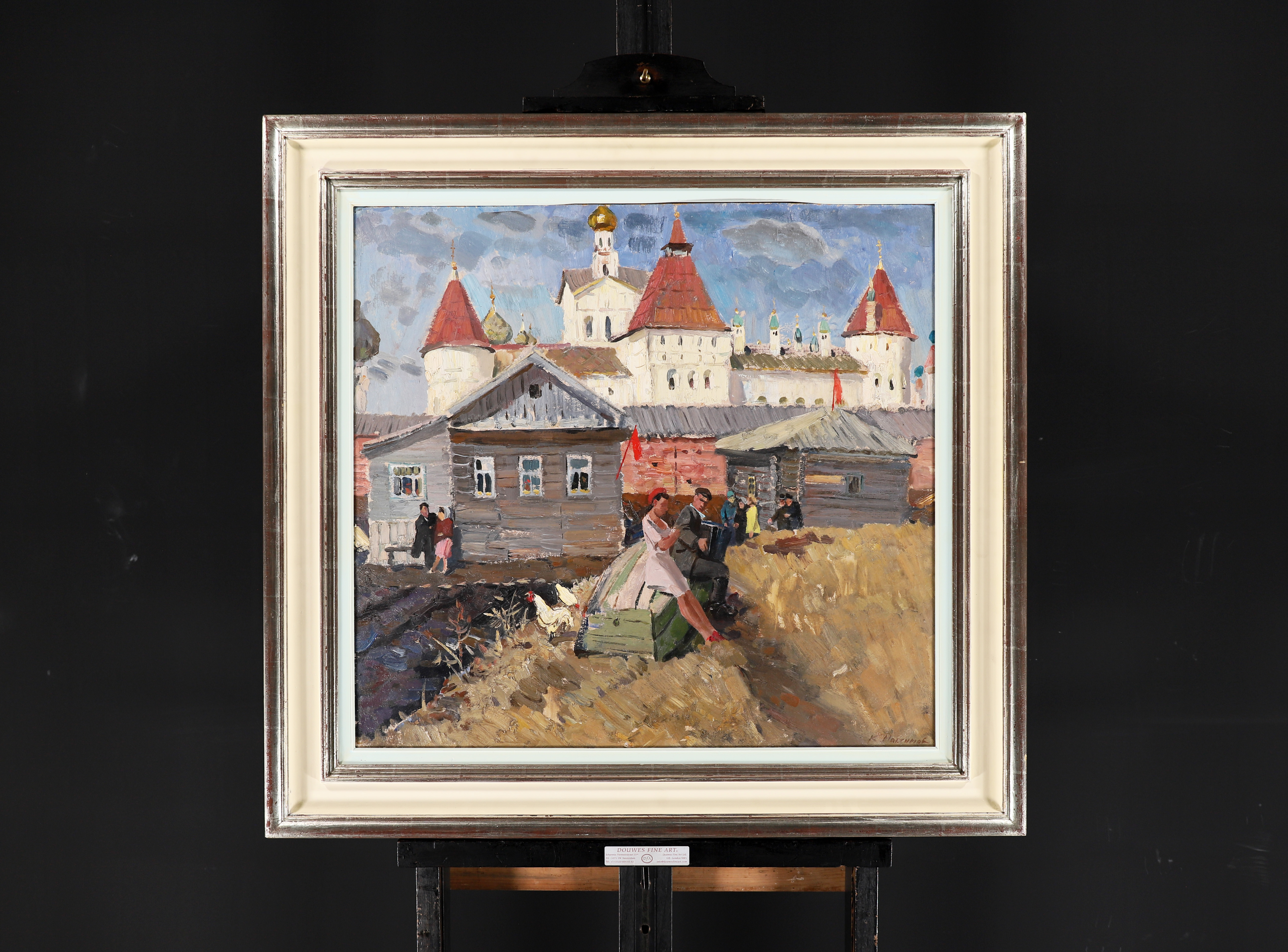
Konstantin M. Maksimov
(Ivanova-Voznesensk pr. 1913 - 1993 Moscow)
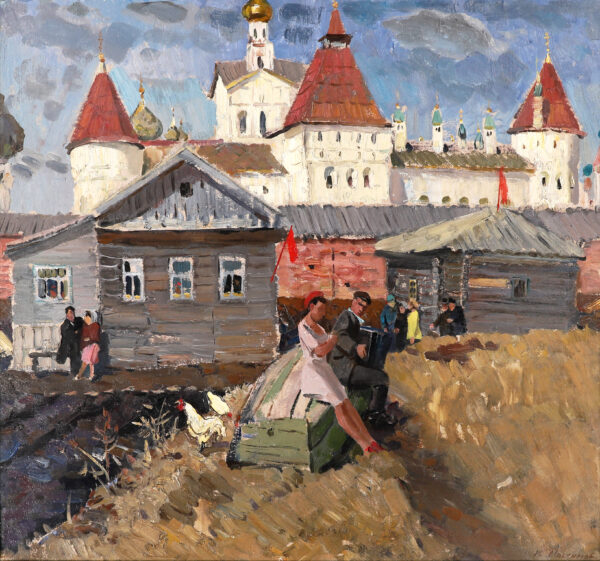
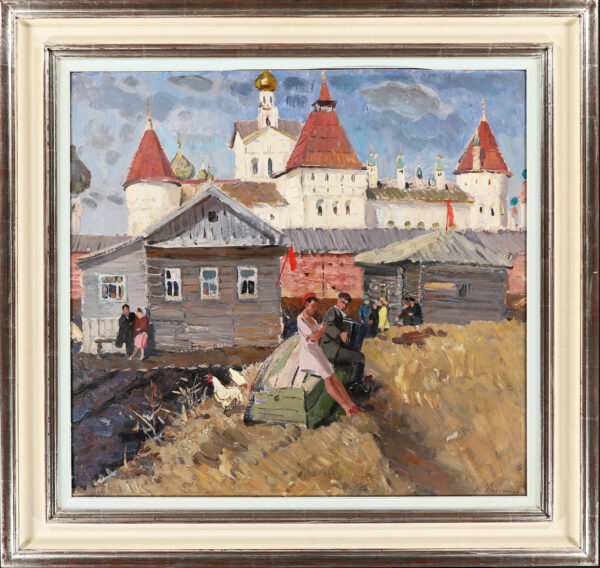
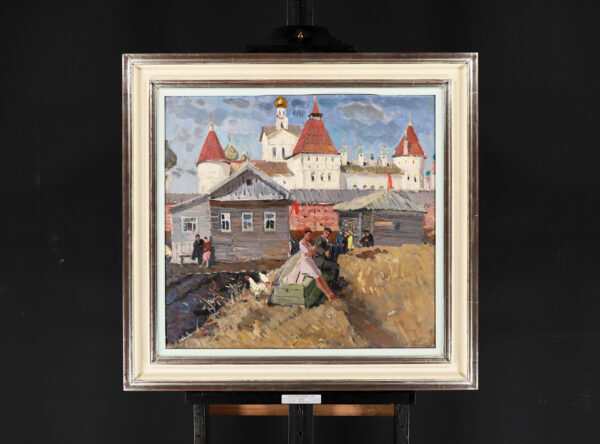
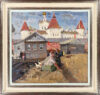
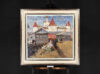
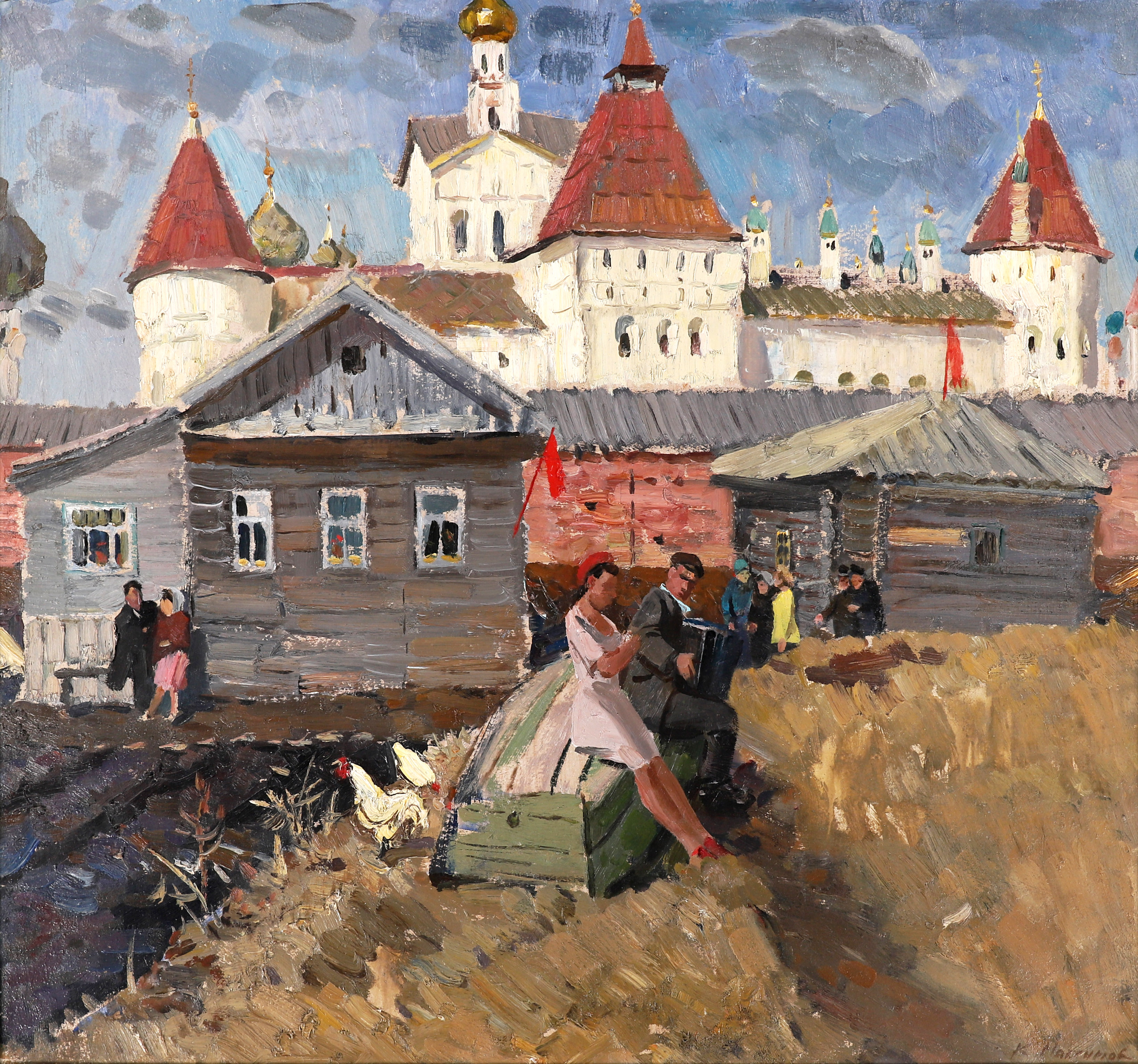
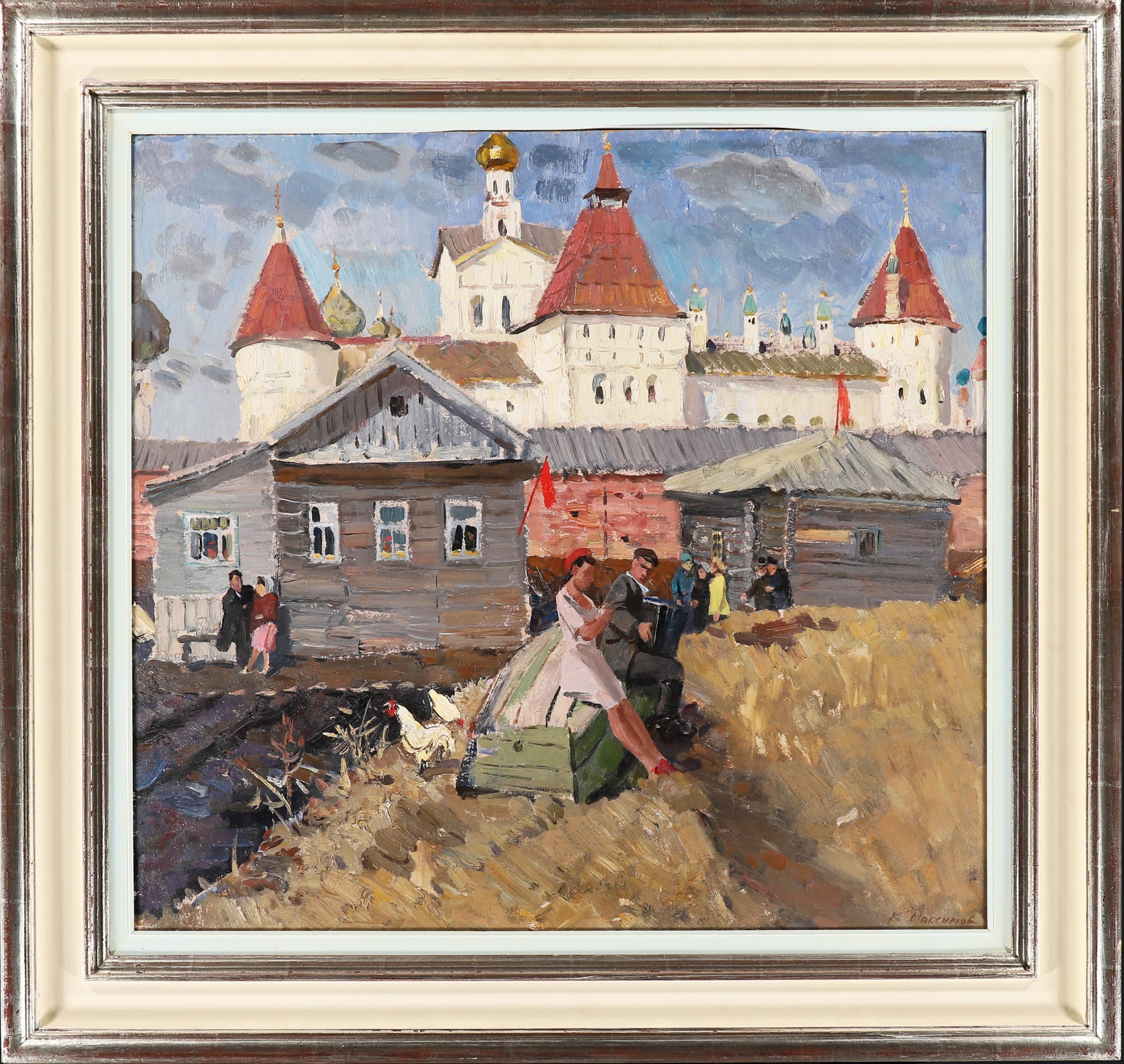
“The Golden Ring city of Rostov Veliky, The White Palace (Belaya Palata)”, c. 1947
Oil on board: 65 x 70 cm; signed lower right K Maksimov
verso: signed and titled Rostov veliki
painted circa 1947
"*" indicates required fields
Notes
The Golden Ring is a ring or circle of cities around Moscow, known for their rich architecture with old churches, monasteries and kremlins. Rostov Veliky (Rostov the Great) is one of Russia’s oldest cities (founded 862) and a key Golden Ring site, renowned for its fairytale-like Kremlin overlooking Lake Nero. Built in the 17th century by Metropolitan Iona, the white-stone Kremlin features silvery domes, towers, and famous bell towers.
Maksimov chose to depict The White Palace (Belaya Palata) in the Rostov Kremlin is a 17th-century architectural highlight in Rostov Veliky, Russia. Situated on the shores of Lake Nero, this historic structure serves as a museum within the fortress, built in 1675 originally. The roof colour is not red as in the painting, perhaps this was done purposefully by Maksimov to better suit the colour palette, or to give a sense of warmth to the painting.
Konstantin Maksimov was born in 1913 in Shatrovo, Ivanovo region and died in 1994. He had his first art lessons at the factory club in Sereda, a village near Shatrova. In 1930 he went to the Ivanovo-Voznesensk Institute of Art, Pedagogy and Technique and then to the Surikov Institute in Moscow (1937 – 1942), where he graduated at the studio of Georgi G. Riazhski with the painting The departure of the Division.
Maksimov won the Stalin prize twice: in 1950 and in 1952, both for a series of portraits and his part in group paintings. One of his best known portraits is Sasha the Tractordriver (1954, Tretyakov Gallery). Beside portraits he was known for his genre-paintings, landscapes and still lifes. In the late 1960’s he also started painting watercolours.
Maksimov took part in all the important All-Union Art exhibitions in Moscow since 1947 and in Soviet Russia in 1960. He also had several personal exhibitions, his first one at the age of 16 (!) in the hall of the People’s House of Sereda, the second one in 1960 in Moscow, Kostroma and Ivanovo and in 1978 one in Moscow and Ivanovo. He became a Peoples Artist of the RSFSR and of the USSR and worked as a professor at the Surikov Art Institute.
In 1955-1957 Maksimov worked in Bejing as a teacher and adviser for the Chinese Academy of Arts. He painted many lovely portraits and landscapes during this stay. He traveled widely after this experience: to Asia (Dagestan, Tadzjikistan), the north (Karelia), to industrial sites like the Donbass, and to Europe (France, Germany, Spain, Italy and Yugoslavia). His paintings are to be seen at the Tretyakov gallery in Moscow, the Russian Museum in St. Petersburg and the Museums of Astrakhan, Tver, Komsomolsk-na-Amure, Kostroma, Ekaterinburg etc.
Provenance
private collection, Russia
private collection, The Netherlands
Literature for reference:
- M. Maksimov, N. D. Sobolevski, Leningrad 1962; K.M. Maksimov, Soviet Artist, Moscow 1977;
- Konstantin M. Maksimov, I. I. Kuptsov, Leningrad 1989;
- A Dictionary of twentieth century Russian and Soviet Painters 1900-1980’s, by Matthew Cullerne Bown, London, 1998, with an illustration on page 195, plate 174
- Socialist Realist Painting, M. Cullerne Bown, London & New Haven 1998, with illustrations on page 269 and 271 of two brigade works under Vasil P. Efanov, illustrations on page 314 and 315, plates 346 & 347
- Maksimov Moscow 1913-1993 / Beijng 1954-1957, catalogue by the Cees Hogendoorn Gallery, Amsterdam 2001;
- Soviet Impressionism, Vern Grosvenor Swanson, Antique Collector’s Club, Woodbridge 2001 with illustrations on page 121, plate 72