
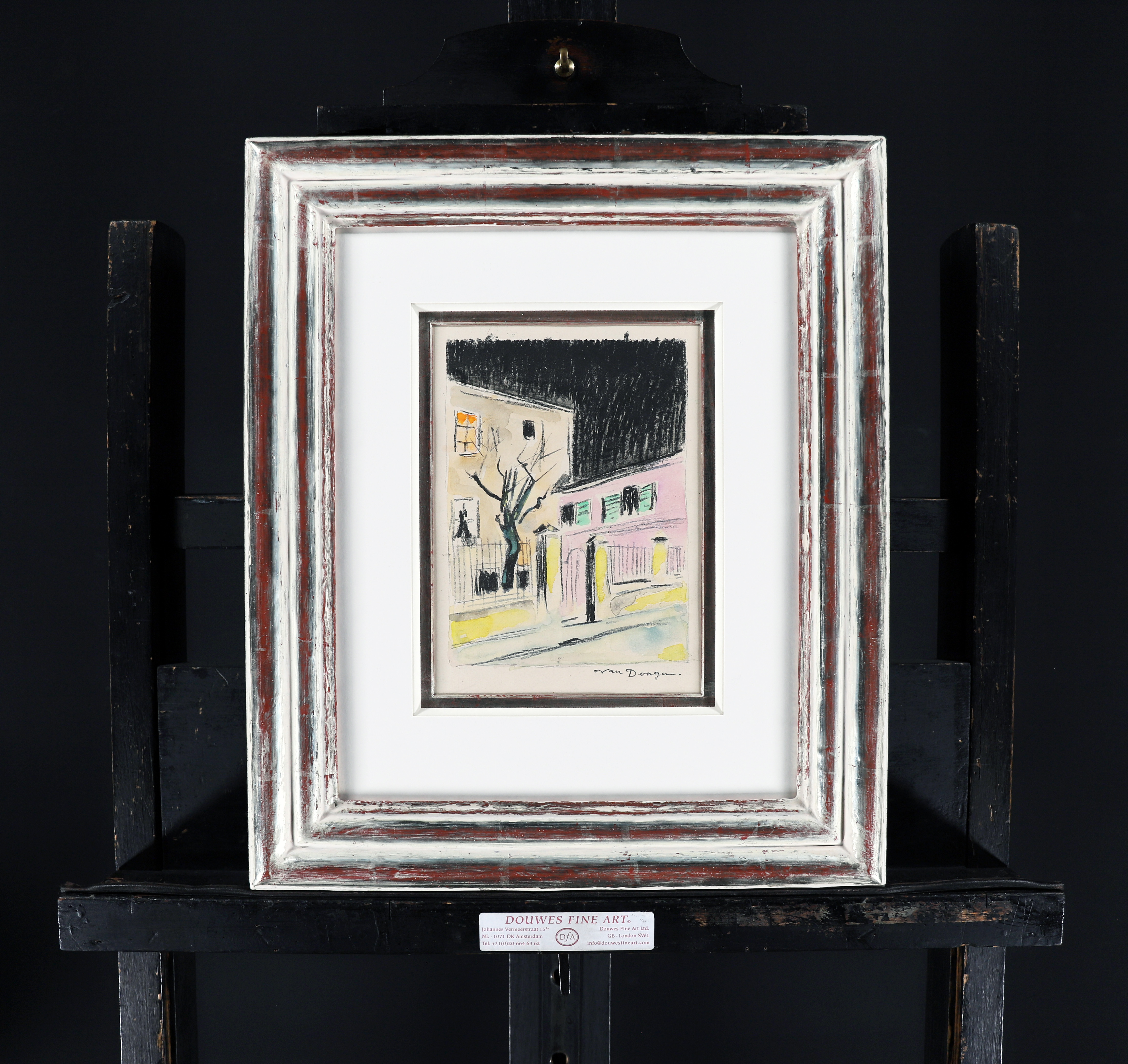
Kees van Dongen
(Rotterdam 1877 - Monte Carlo 1968)
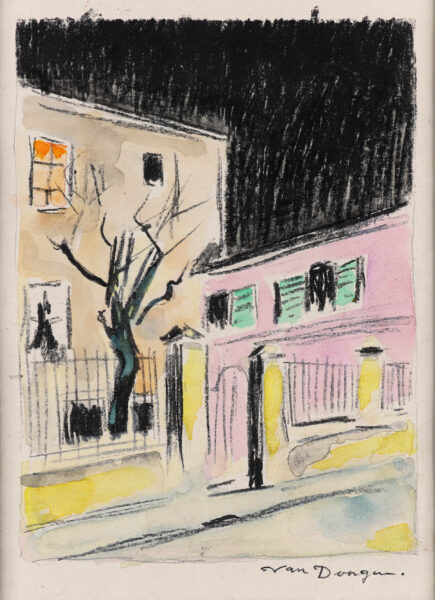
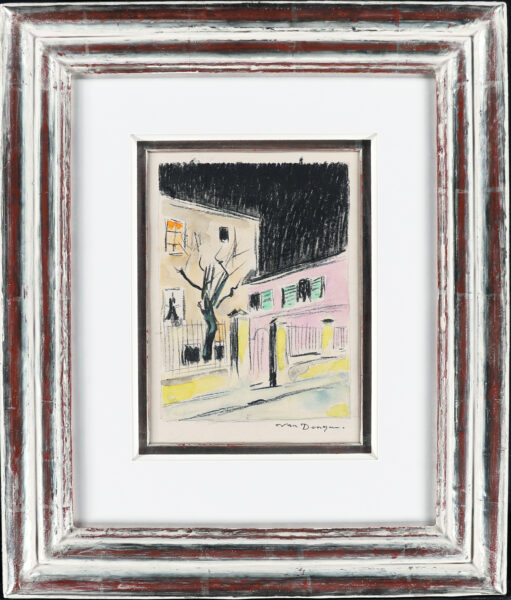
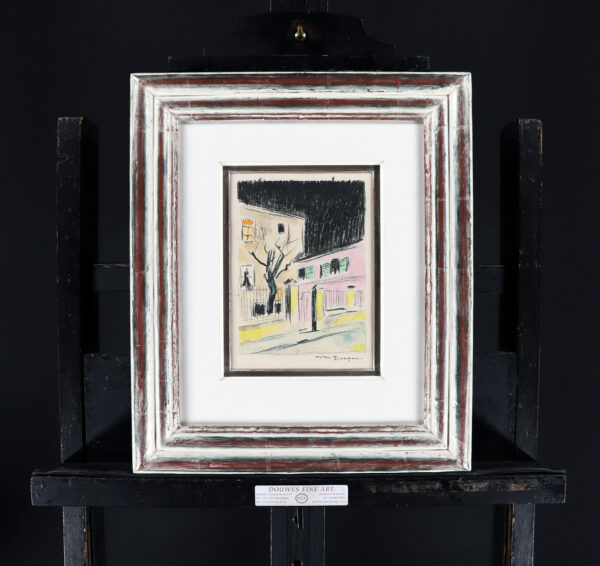
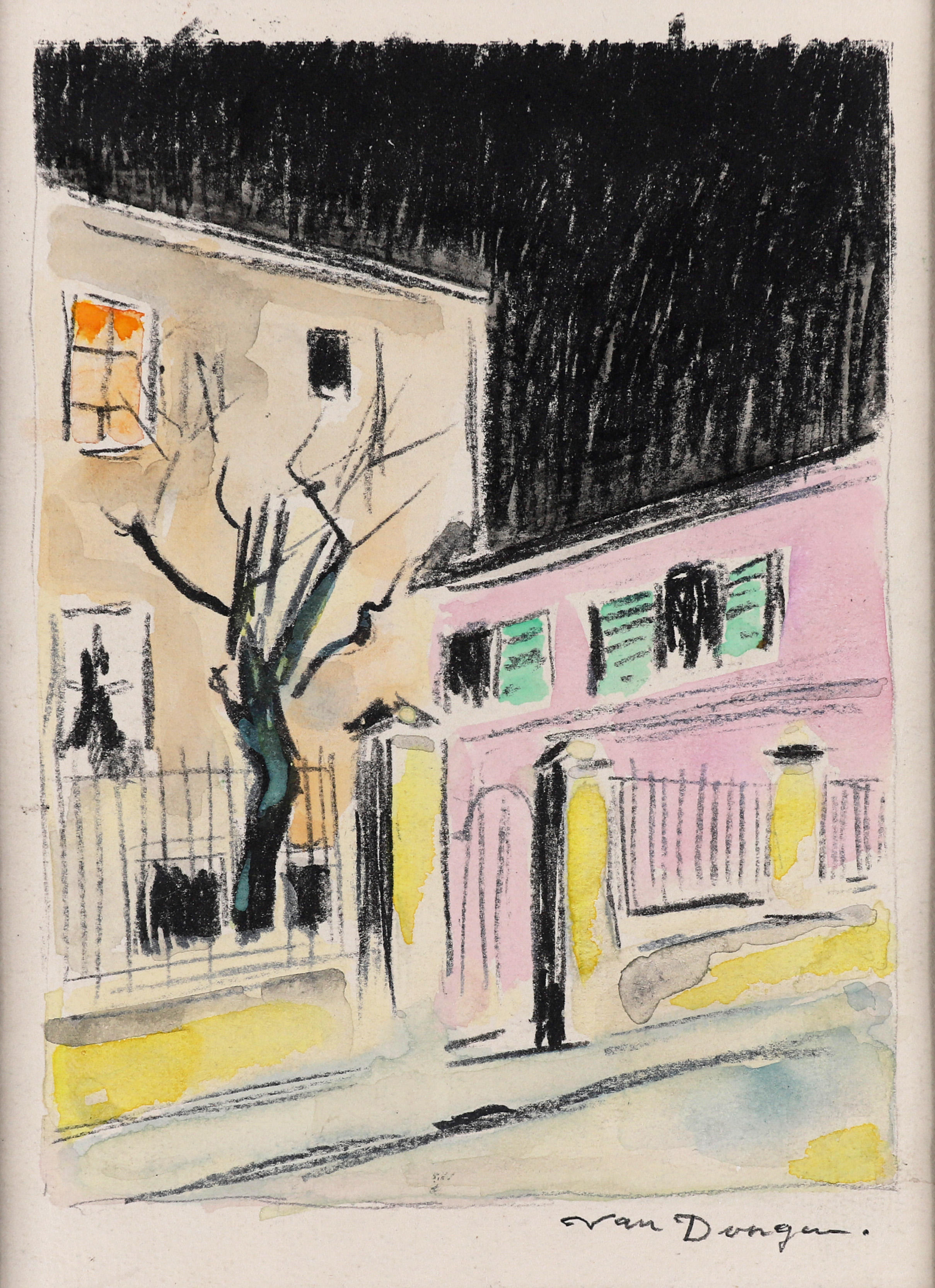
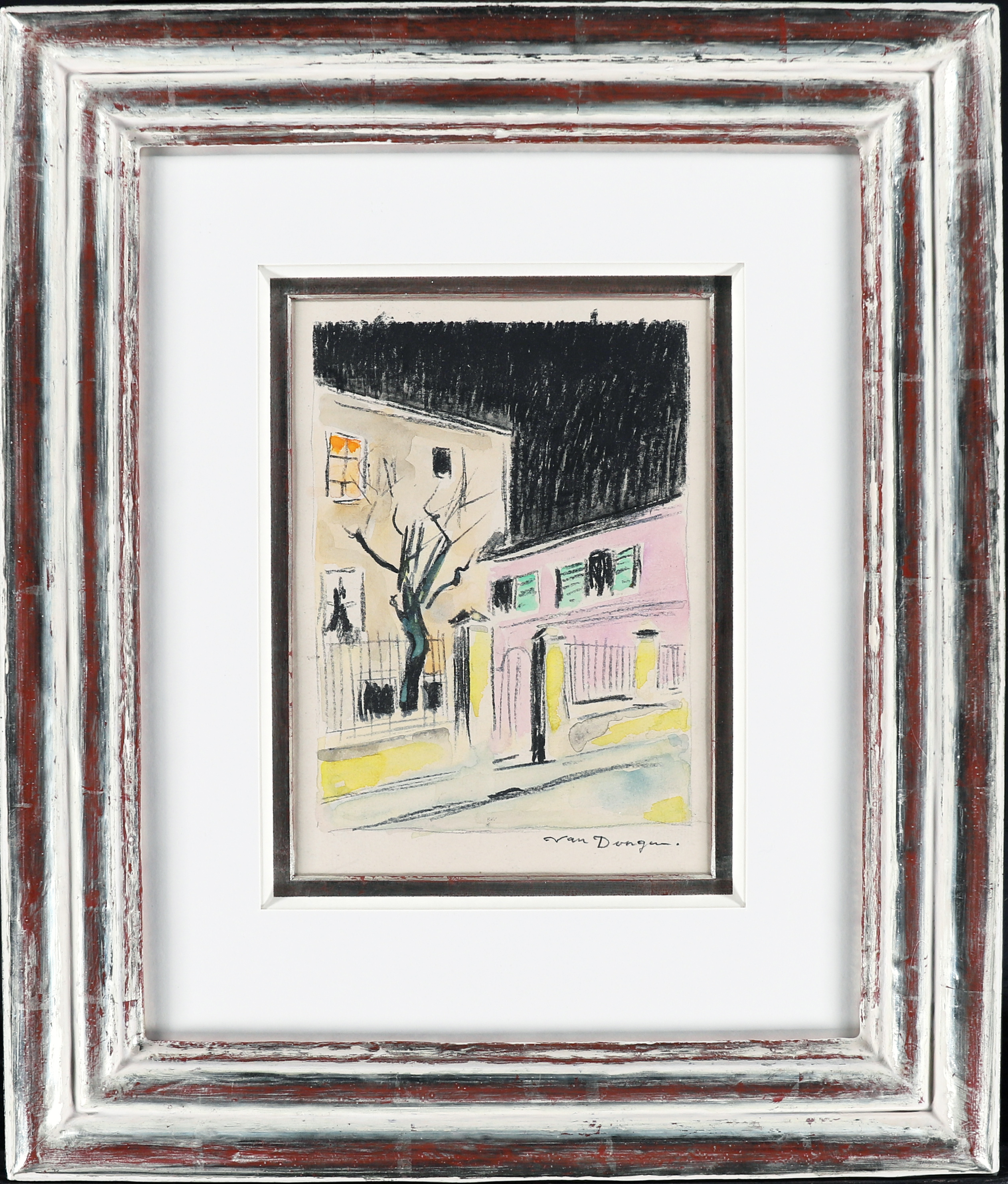
‘Un coin fameux de la Butte. L’impasse Girardon’, c. 1949
Unique Watercolour over litho on paper: 24 x 21,5 cm
signed ‘van Dongen.’ (lower right)
Inscribed ‘Dorgelès No. 17’ lower right.
"*" indicates required fields
Notes
Kees van Dongen was a Dutch-born French painter and printmaker who was one of the leading Fauvists and was particularly renowned for his stylized, sensuously rendered portraits of women.
This is the original watercolour by Kees van Dongen that was later used as a study to create the lithograph version that was printed in the book “Au Beau Temps de la Butte” by Roland Dorgelès, 1949, with illustrations and the additional suite of twenty lithographs by Kees van Dongen. Printed by Rene Guillard, Paris. Documented in the catalogue raisonné of Van Dongen’s graphic work by Jan Juffermans. Dorgelès published 100 editions including a separate suite with the 20 lithographs by Kees van Dongen. He also published 5 copies on Arches laid paper, signed by the author, containing a double suite of lithographs printed on Arches paper, and 4 original lithographs hand-colored (watercolour and gouache) by the artist, numbered 1 to 5.
The current original of Girardon was part of this last group, specifically from book number 3 of 5 (see picture at the end).
Impasse Girardon is a historic dead-end alley (and now part of the 18th arrondissement’s streetscape) located on the north slope of the Butte Montmartre in Paris, France.
The 1949 book is a memoir by Dorgelès recalling the bohemian artistic life of Montmartre in the years before World War I. Dorgelès looks back on his youth in the early 1900s, when as a young, still-unestablished journalist he spent most of his time among the artists and writers of Montmartre’s Butte. He recalls the painters of the Bateau-Lavoir (Picasso, Utrillo, Van Dongen, Suzanne Valadon, Laurencin). It’s a portrait of a bohemian world that was as hard-scrabble as it was carefree.
Van Dongen himself was part of that same Montmartre circle Dorgelès is remembering, so having him illustrate is not incidental. Van Dongen illustrated his personal view and memories of the vanished milieu that is described in the book.
Some of the painter’s most famous works depict fashionable celebrities, including the French actress Brigitte Bardot. “The essential thing is to elongate the women, especially to make them slim,” he said of his models. “After that, you just need to make their jewelry bigger.”
Associated with Fauvism early in his career (he participated in their first exhibition), Van Dongen introduced a range of edgy urban subjects that went further in challenging social norms than Matisse, Derain, Vlaminck and others, who stuck to traditional bourgeois themes (still-life, landscape, portraits, and interiors).
Born Cornelis Theodorus Maria van Dongen on January 26, 1877 in Rotterdam, Netherlands, he studied at the Akademie voor Beeldende Kunsten of Rotterdam, where he created somber-toned landscapes inspired by Rembrandt. Financed by his father, the artist moved to Paris in 1897 where he frequented the bars and cabarets of Montmartre. Affiliated with the Fauvists Henri Matisse, Maurice de Vlaminck, and André Derain, Van Dongen’s use of color and expressive line became integral to his style.
In December 1905, Kees van Dongen was invited by Picasso to move into a studio in the Bateau-Lavoir. They became friends and were evenly matched in the battle to be part of the latest French art. Van Dongen and Picasso attract attention with their daring technique and conquer the Parisian art market side by side. In 1926, the artist was inducted into the French Legion of Honor, and, in 1927, awarded the Order of the Crown of Belgium. Van Dongen died on May 28, 1968 in Monte Carlo, Monaco at the age of 91.
Today, his works are held in the collections of The Museum of Modern Art in New York, the Rijksmuseum in Amsterdam, the National Gallery of Art in Washington, D.C., and the Musée de l’Orangerie in Paris.
Provenance
- Private collection, The Netherlands
- Kloppart Collections
- Private collection, The Netherlands
Literature
- Roland Dorgelès, ‘Au beaux-temps de la Butte’, Paris 1949.