


Balthasar van der Ast
(Middelburg before 1590 - after 1656 Delft)
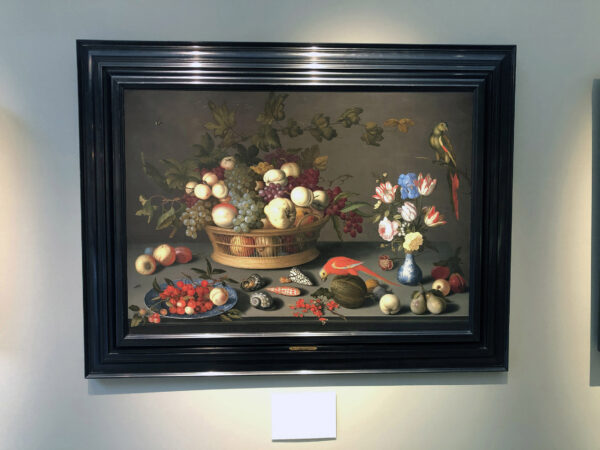
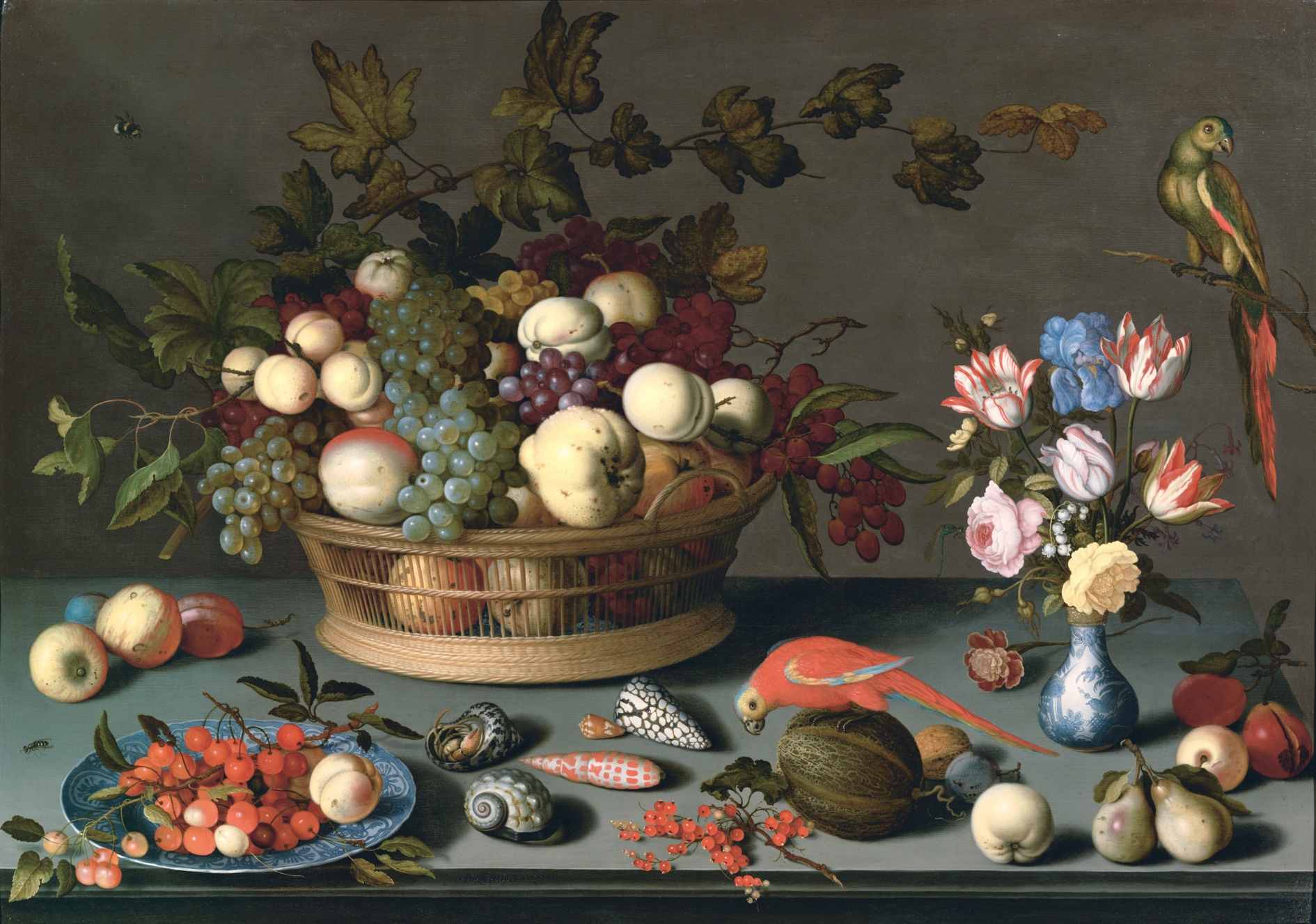
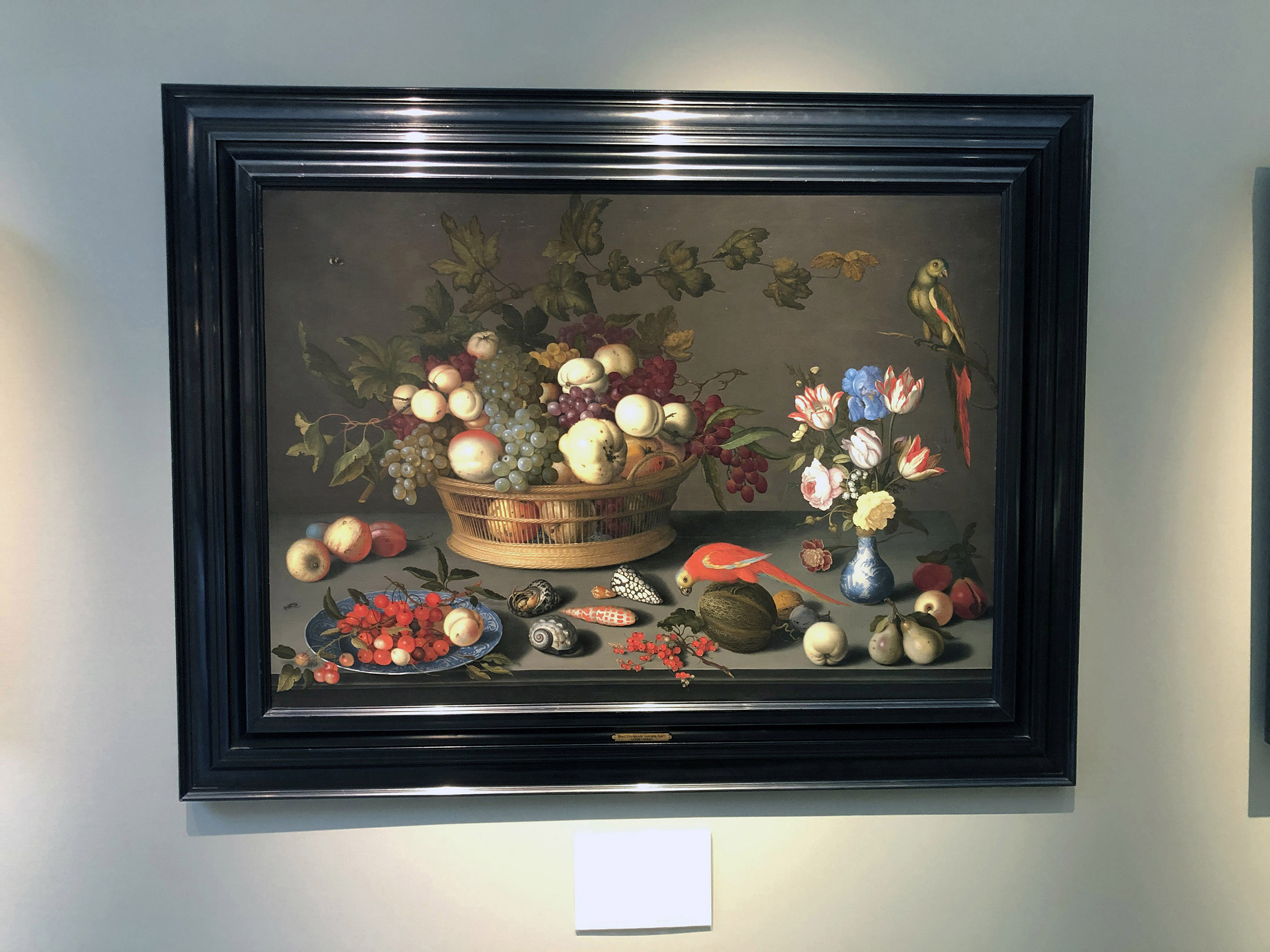
“A Still Life on a table with grapes and other fruits in a basket, cherries on a Delft plate, tulips, irises and other flowers in a Wan-li vase, a group of shells, a parrot perched on a Melon and another perched on a branch”
Oil on panel: 75 x 107 cm;
signed on the slab ‘B.vander. ast”(l.m.)
"*" indicates required fields
Notes
The present still life by Balthasar van der Ast is a true masterpiece of the first half of the 17th century. Van der Ast can be seen as one of the most important still life painters from this era. This example of his work is exceptional both in quality and in size. To find his paintings in such a superb condition is very rare.
It is one of the very few large showpieces that he made and probably the finest and largest panel. In fact it was a showcase of the various objects, kinds of fruit and flowers, shells (for which he was very famous), porcelain, exotic birds, etcetera, which the artist could paint. It is possible to view each separate item as a still life in its own right.
The objective was to demonstrate the artist’s full range of abilities, techniques and subject matter. This gave the client the possibility to select a favourite subject , so he could order a still life painting according to his wishes and possibilities.
As such it is a kind of catalogue of the possibilities and a showcase.
Balthasar van der Ast, a native of Middelburg, trained in the studio of his brother-in-law Ambrosius Bosschaert the Elder, whom he followed to Bergen-op-Zoom, to Utrecht, and ultimately to Delft where he enrolled in the painter’s guild and remained until his death in 1657. Van der Ast was highly esteemed in the seventeenth-century and his work could be found in some of Europe’s most distinguished collections including the prince of Orange, Frederik Hendrik, and his wife Amalia von Solms. Notably, two paintings by his hand were cited in their 1632 collection inventory as ‘a basket with fruit and a basket with flowers’ (now in the National Gallery of Art, Washington, D.C., inv. nos. 1992.51.2 & 1992.51.1).
Literature
- “Die Weltkunst”, IX, no. 28/29 and X, no. 50;
- “Nieuwe Rotterdamse Courant”, 29 June 1935;
- “De Zakenwereld”, Amsterdam, 1935, no14; Apollo Magazine, May 1955 Vol.61, p. 132;
- “Connoiseur”, May 1955, Vol. 133, p. XVIII;
- J.Bol, “The Bosschaert Dynasty” 1980, no. 117, pp. 85-86.
Provenance
- The Reverend J.Willemsen, Middelburg, 1780;
- Kalbfleisch, Flushing; S.Westerman, Amsterdam by 1935;
- I. Heitmanek-Engeling, Zürich;
- with Eugene Slatter, London;
- Alexander Leger Galleries, London, 1977;
- in a private American collection, since 1979;
- acquired by a European collector.
- Douwes Fine Art, Amsterdam, 2009
- private collection, The Netherlands
Exhibited
- Amsterdam, Kunsthandel P. de Boer, “Bloemstukken”, 1935, no. 7;
- London, Eugene Slatter,”Dutch and Flemish Masters”, April – July 1955, no. 13;
- Amsterdam, Gebr. Douwes Fine Art, “Old Master Paintings until 1805”, 1995, cat. no. 2
Published
“Die Weltkunst”, IX, no. 28/29 and X, no. 50;
“Nieuwe Rotterdamse Courant”, 29 June 1935;
“De Zakenwereld”, Amsterdam, 1935, no14; Apollo Magazine, May 1955 Vol.61, p. 132;
“Connoiseur”, May 1955, Vol. 133, p. XVIII;
L.J.Bol, “The Bosschaert Dynasty” 1980, no. 117, pp. 85-86.