
Jeronimus van Diest
(1631 - The Hague - 1684)
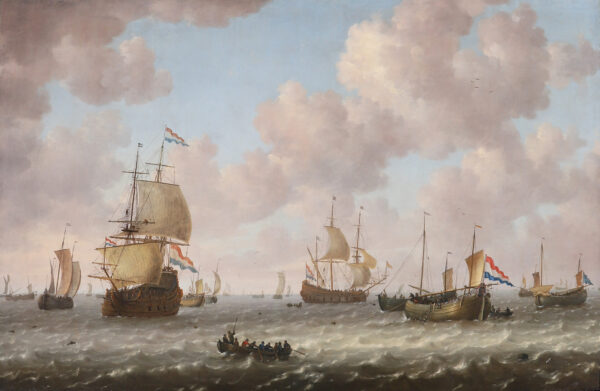
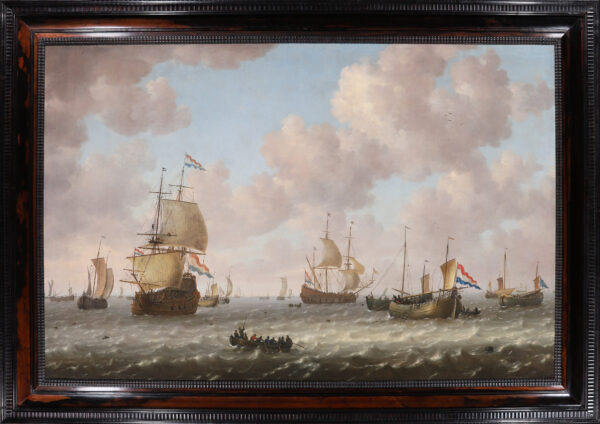
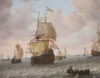
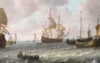
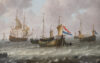
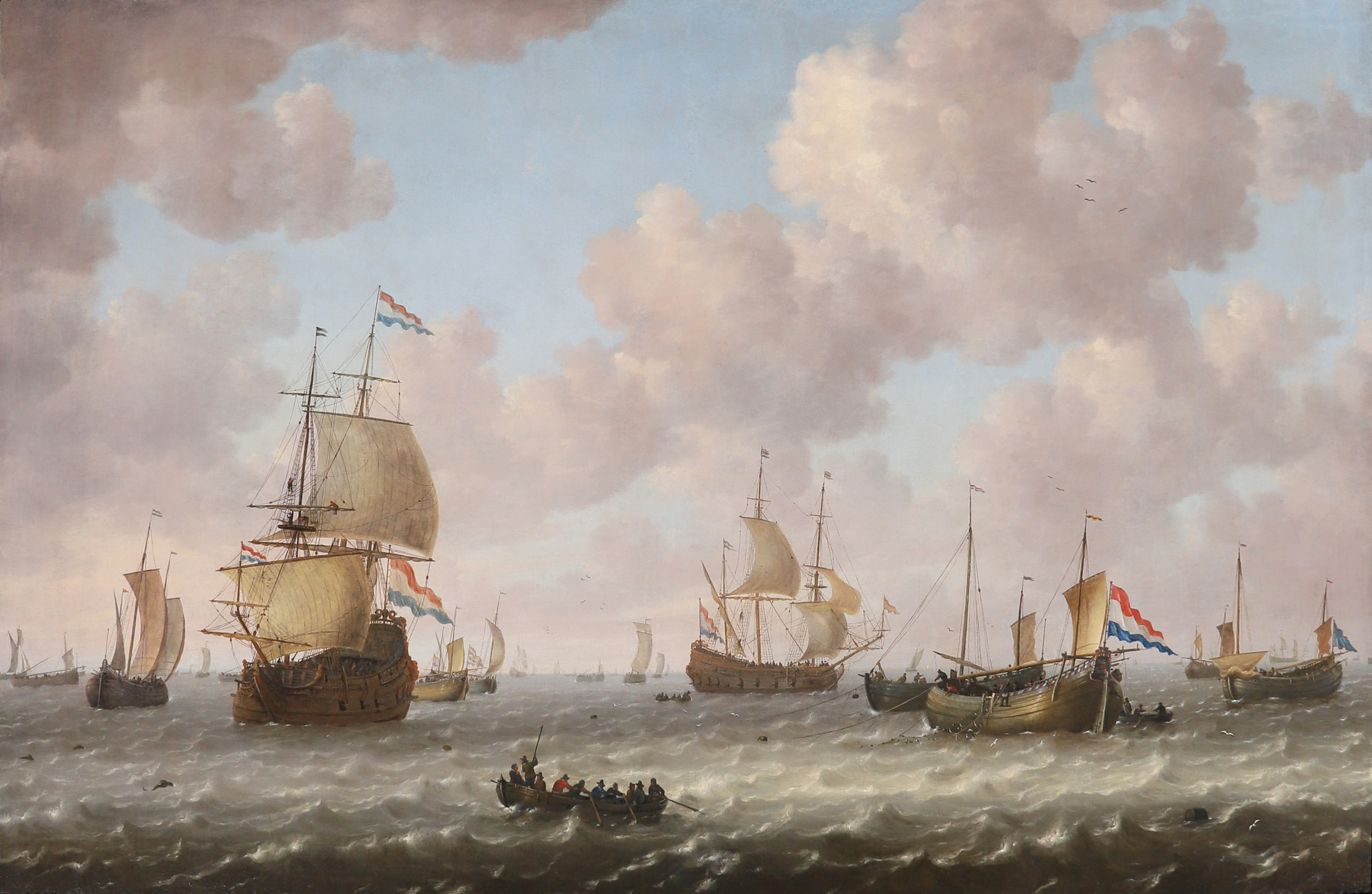
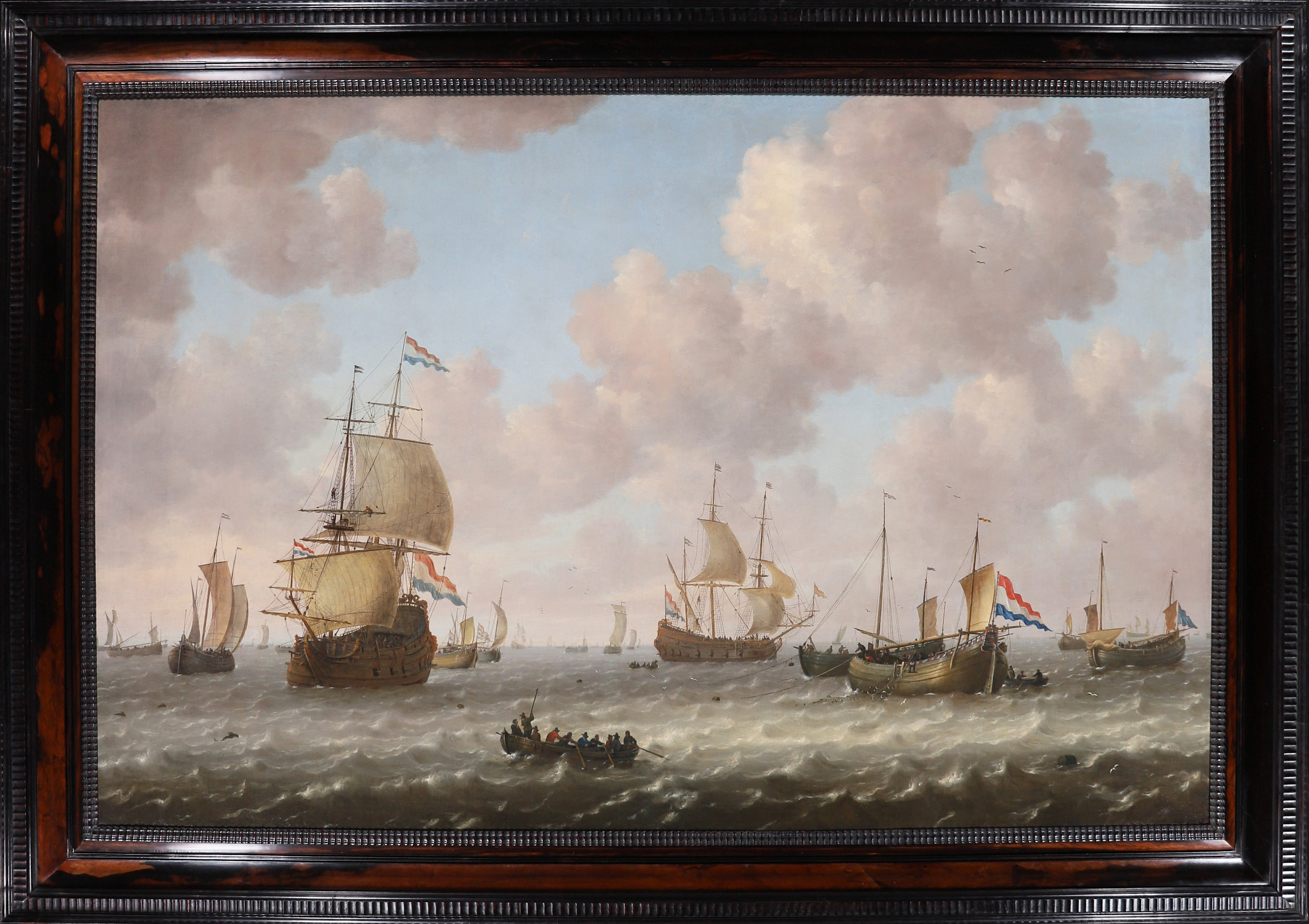
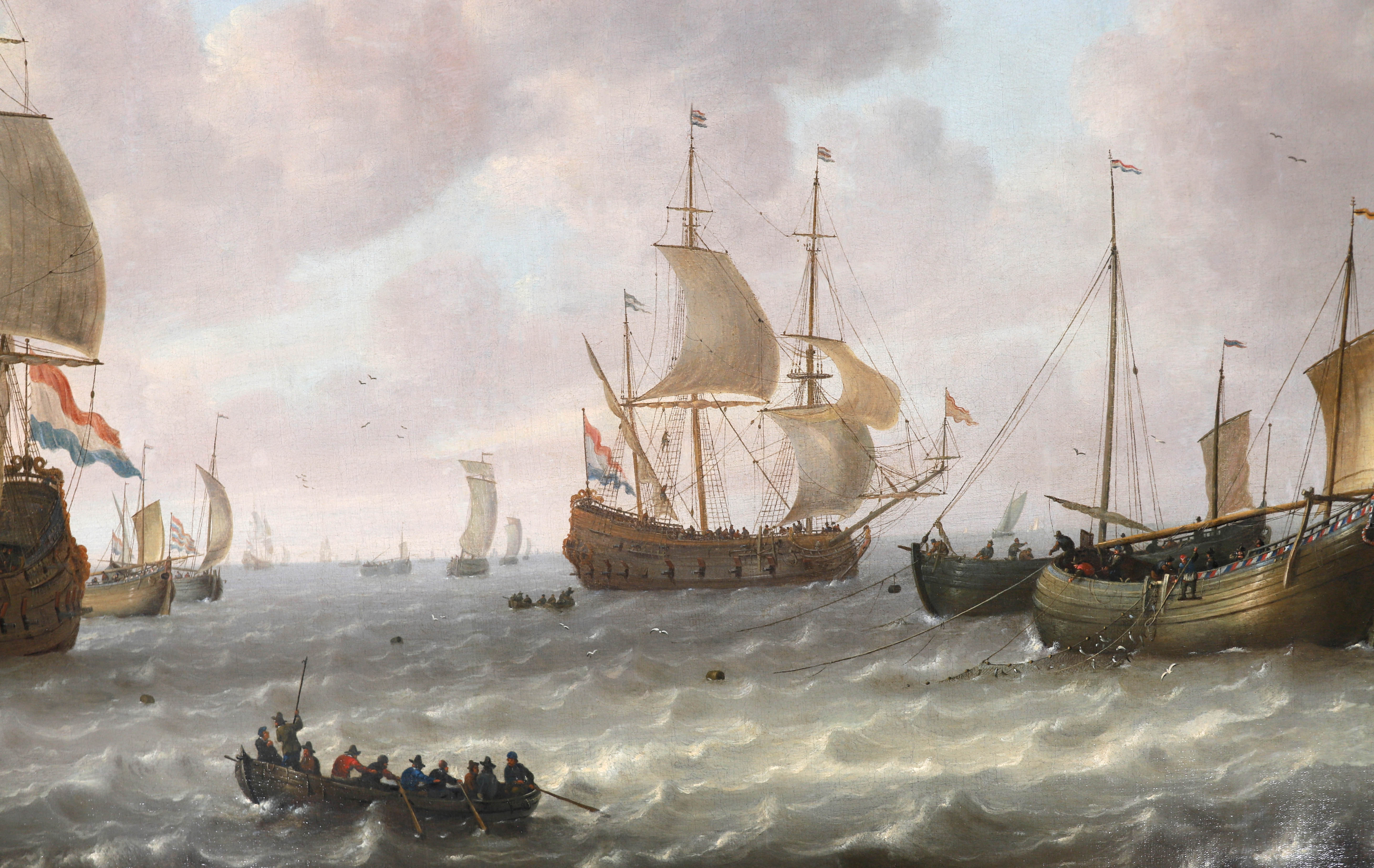
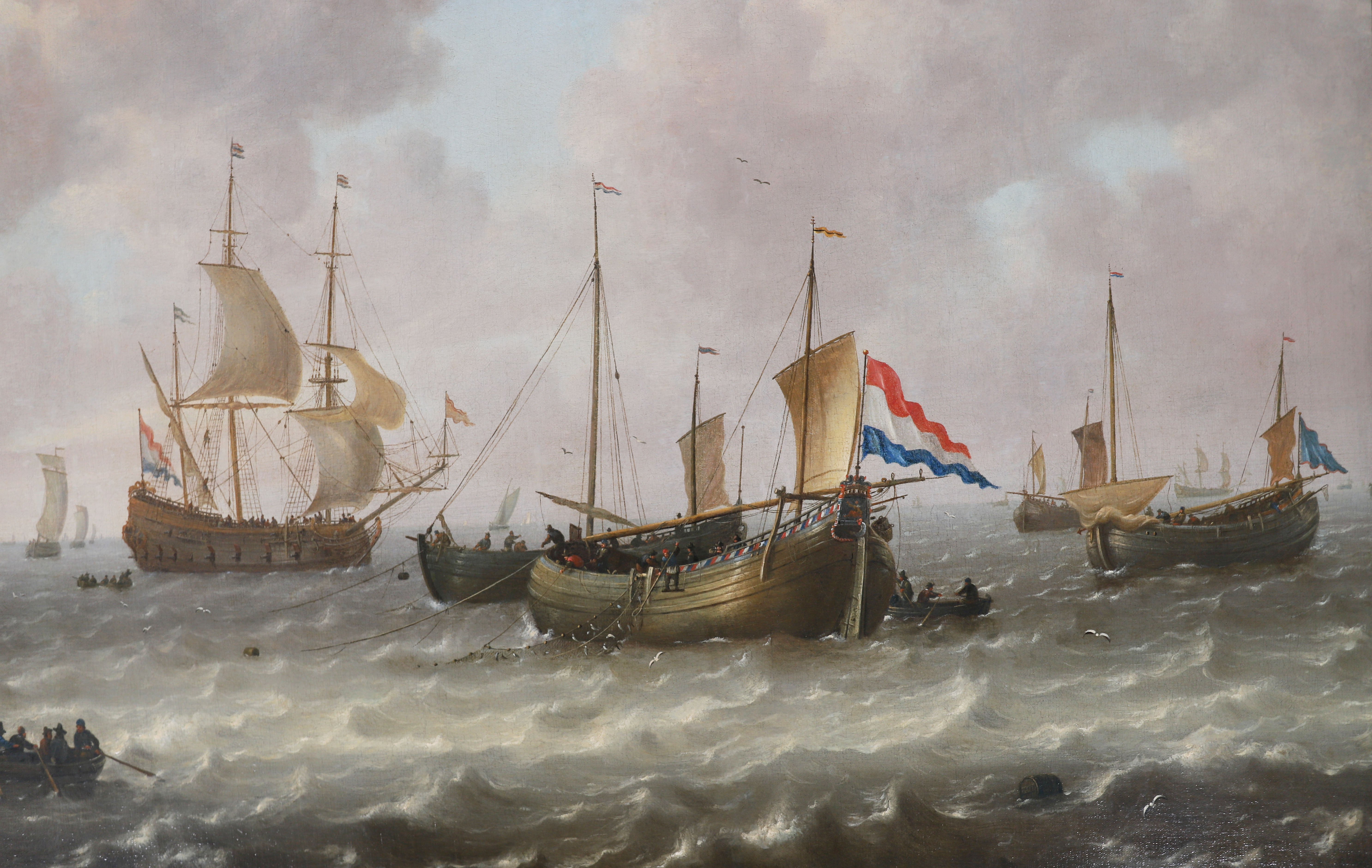
“Herring Busses under the Protection of Men-of-War”, c. 1652-1654
Oil on canvas: 105,5 x 161 cm;
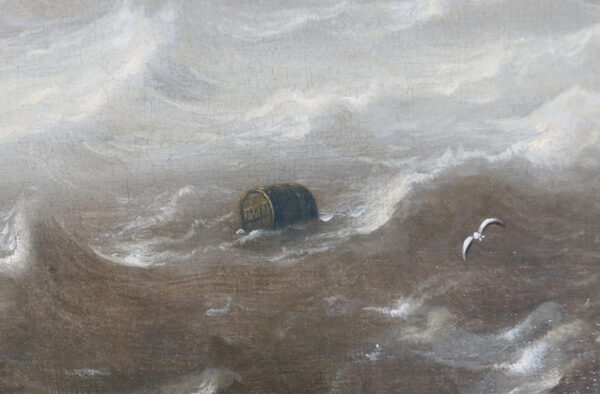
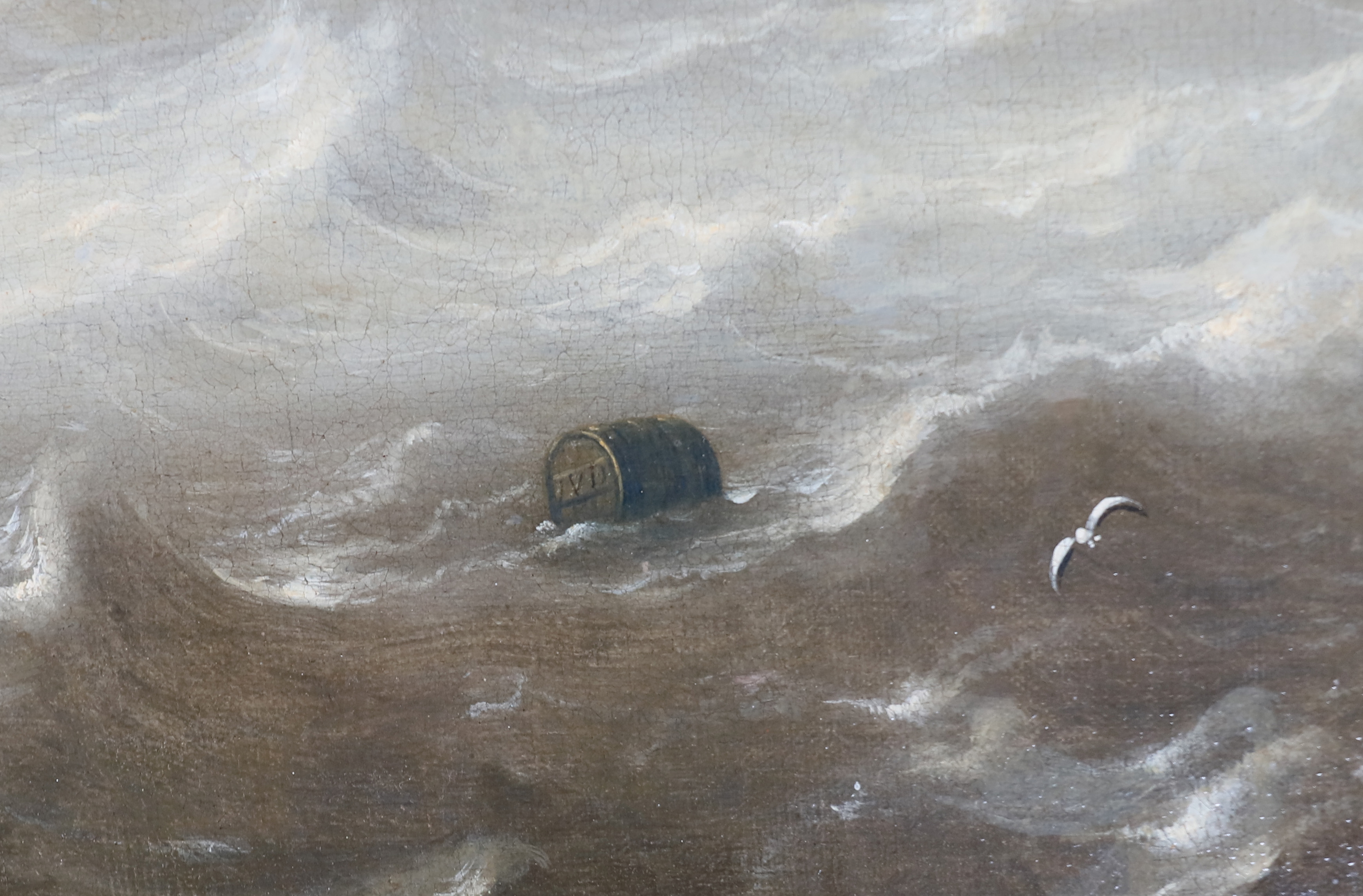
Monogrammed ‘I VD’ on the barrel at bottom right
"*" indicates required fields
Notes
The Herring buss was a relatively rare motif in seventeenth-century marine painting, which makes the formal emphasis on the buss in the right-hand foreground all the more remarkable here.
Jeronimus van Diest’s career as an artist spanned more than a quarter of a century, during which time he must have been fairly productive. Every now and then seventeenth-century probate inventories, especially those in The Hague, mention ‘small sea-pieces’, ‘beaches’ or ‘pieces of water’ by Van Diest.
The pictorial theme of herring fishing under escort was an important and demanding one. Herring fisheries were an important mainstay of Dutch economic prosperity, without which the Golden Age may well have been more silver than gold. The large format of this painting suggests it was a commissioned work, and the care with which Jeronimus van Diest approached the task was appropriate to the subject matter’s importance. Before Van Diest made a single brushstroke, he undertook a considerable process of planning and reflection.
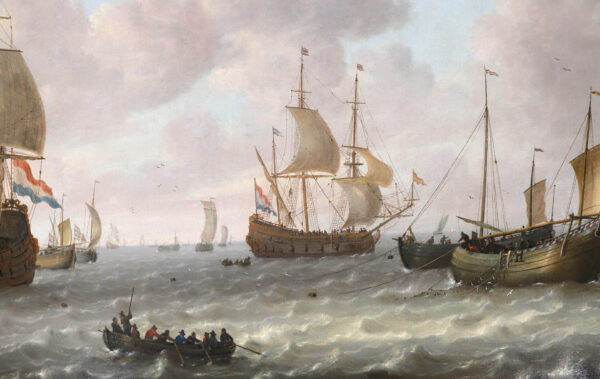
The herring fishing grounds lay in the northwest part of the North Sea, close to the Shetland Islands, opposite the Norwegian coast. The picture’s setting is thus the open waters of the North Sea. The large group of ships is sailing before a fresh breeze in seasonably good weather. In fact, herring could be caught only between 24 June and 14 September.
Light enters the picture from the far left. The wind pushes rising cumulus clouds from left to right, alternating with clear patches of blue sky. This is echoed in the structure of the sea, where the contrast between light and dark is muted and gradual. As a result, the many ships extending over a wide expanse of water are clearly visible; in terms of content, they likewise form a coherent whole. The effect of the wind, visible in the sails, can also be seen in the agitated surface of the water. There is some difference in the height of the waves, which form diagonal rows. The majority of the crests are topped with foam. The lively alternation of clouds and clear patches corresponds to patterns on the sea, as dark clouds cast their shadows on empty stretches of water. But the viewer is offered good light conditions; no shadows occlude the subject matter.
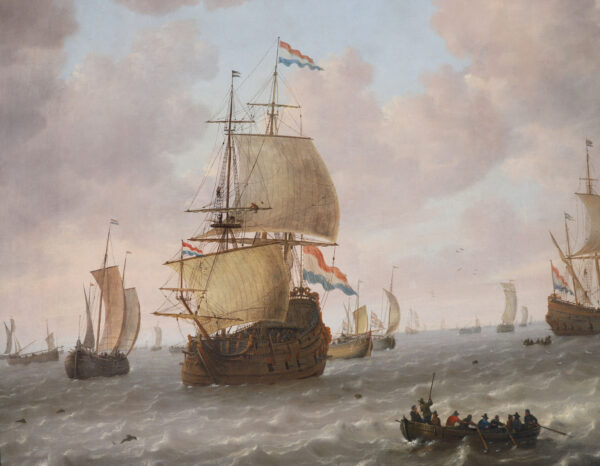
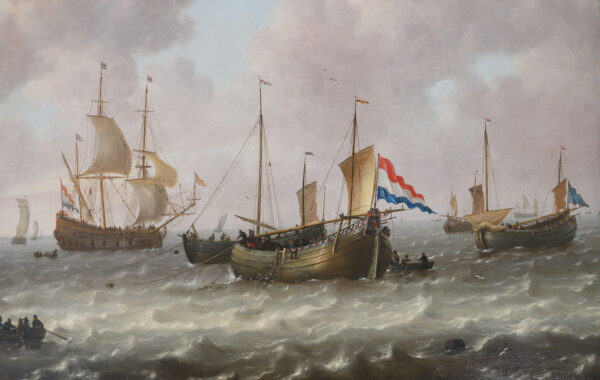
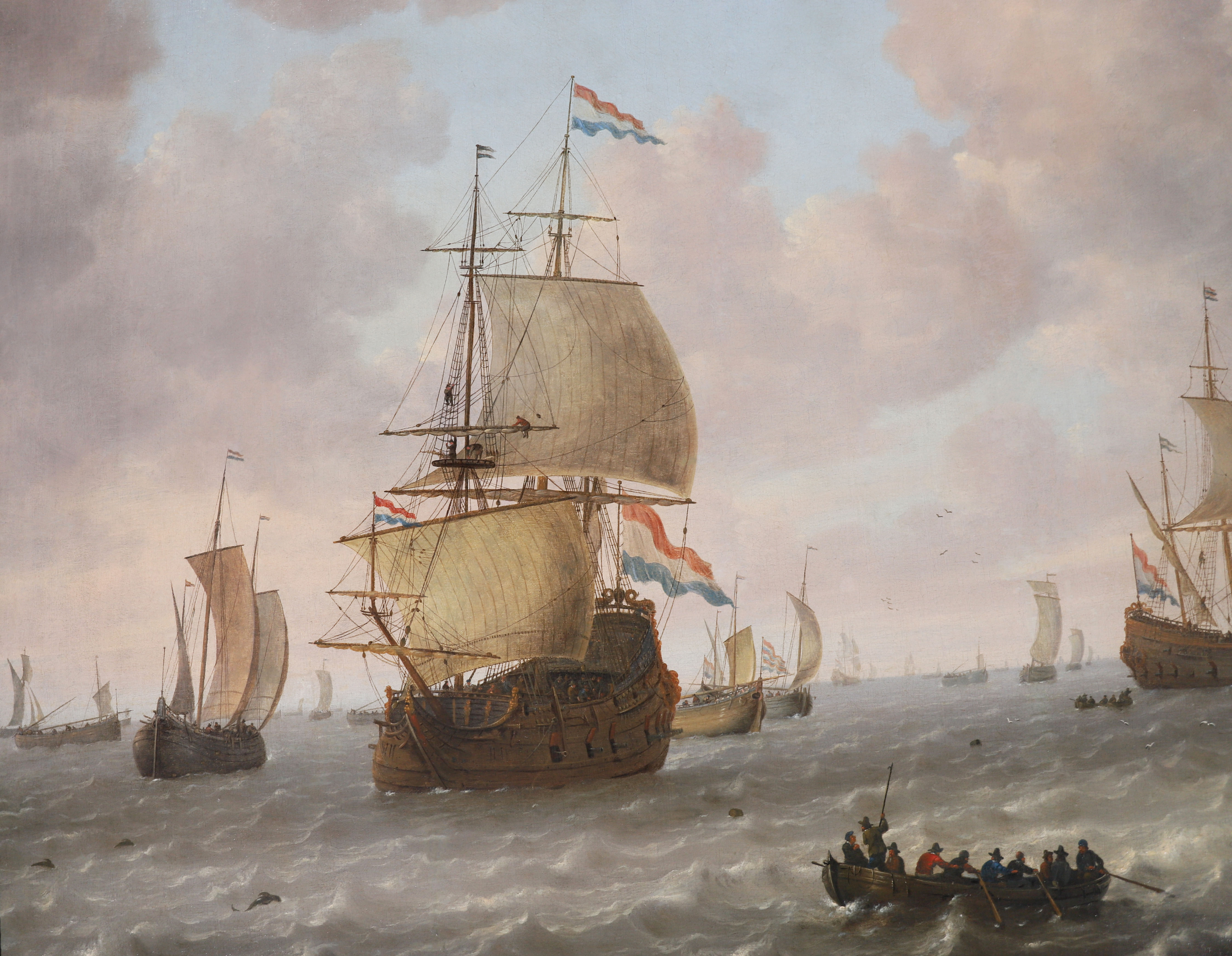
Only a few different kinds of vessel feature among the large number of ships shown. The open water is filled with herring busses and three-masters, the ships which are the thematic focus of the painting. The viewer’s eye is drawn into the picture by the rowing boat in the foreground, which is filled to capacity, with two smaller rowing boats acting as subsidiary motifs. Van Diest was careful to allow no other type of vessel to divert the viewer’s attention from the picture’s main theme. Only the faint outline of a single-master and its spritsail can be made out on the horizon to the right. A herring buss and a three-master occupy the middle ground of each half of the picture. These two vessels are the only ones to be clearly depicted in three-quarter view, although they face in different directions. Beginning from these two main vessels, a series of busses and another three-master form diagonal lines extending into the distance. This arrangement leaves the view towards the horizon open in the left centre of the picture. At the same time, further herring busses lead the eye towards the edges of the picture. The composition astutely draws our attention to the great expanse of the North Sea, here extending in all directions.
It was wise of Van Diest to make use of the principle of composition developed by Simon de Vlieger (c. 1601-1653) in his marine parade paintings. The structure creates a spatial continuum, lending coherent order to a seascape full of varied motifs. Unlike landscape painting, in this genre there were no pre-established paths or bearings. Van Diest took care not to muddle the compositional system with insignificant subject matter. At the same time, he followed De Vlieger in setting the vessels on different courses in order to moderate the strictness of the composition. His profound understanding of De Vlieger’s work is the basis for his confident transformation of De Vlieger’s thronged ceremonial riverscape, adapting the form to a different subject matter and to the open reaches of the North Sea.
The herring buss was a relatively rare motif in seventeenth-century marine painting, which makes the formal emphasis on the buss in the right-hand foreground all the more remarkable here. The only other painter to include the vessel in his repertoire and highlight it in a similar way was Willem van de Velde the Younger (1633-1707), who depicted the buss in the form of a ship’s portrait around 1670, as he did with many other kinds of vessel. The impetus for emphasising the herring buss in this painting seems to have come from Simon de Vlieger, who is known to have created two works on herring fishing between 1649 and 1651: one is held in the Rotterdam Maritime Museum, the other in Budapest Museum of Fine Arts.
Rather than present the viewer with the lavishly decorated stern of the three-master, Van Diest chooses to highlight the stern of his picture’s main subject, the smaller, more modestly built vessel. The artist also uses the fishing fleet to depict herring busses from different angles, giving a comprehensive view of this type of ship. At the far left of the picture there is another stern view of a herring buss with its characteristic square sails; at the far right, the bow of another buss is visible. Behind and to the left of the main motif, yet another buss is seen in broadside view.
Provenance
- Collection of Baron van Dedem, Netherlands
- Wolff Gallery, Amsterdam, before 1940
- Private collection, The Netherlands
- Hoogsteder Gallery, The Hague, 1991
- Inder Rieden Collection, since 1991
Literature:
- Gerlinde de Beer, “The Golden Age of Dutch Marine Painting – The Inder Rieden Collection”, edited by Charles Dumas, Primavera Pers, Leiden 2019, Catalogue II, no. 43, page 682-694.
- Charles Dumas, Gerlinde de Beer, “In de ban van de zee – De Gouden Eeuw van de Nederlandse marineschilderkunst”, De Inder Rieden Collectie, Museum Bredius, 2019, Wilco, Amersfoort, The Netherlands, no. 60, with colour ill.
- Buijsen, in: Buijsen/Ekkart/Dumas 1998, p. 121, fig. 3 in colour
Exhibition
- Charles Dumas, Gerlinde de Beer, “In de ban van de zee – De Gouden Eeuw van de Nederlandse marineschilderkunst”, De Inder Rieden Collectie, Museum Bredius, 2019, Wilco, Amersfoort, The Netherlands, no. 60, with colour ill.
- The Hague 1998/99, without no.