
(1851 - Paris - 1934)
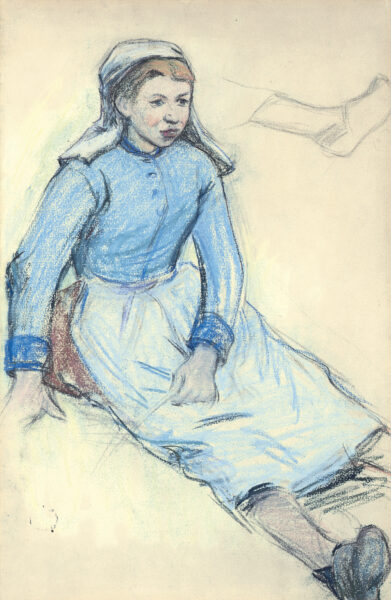
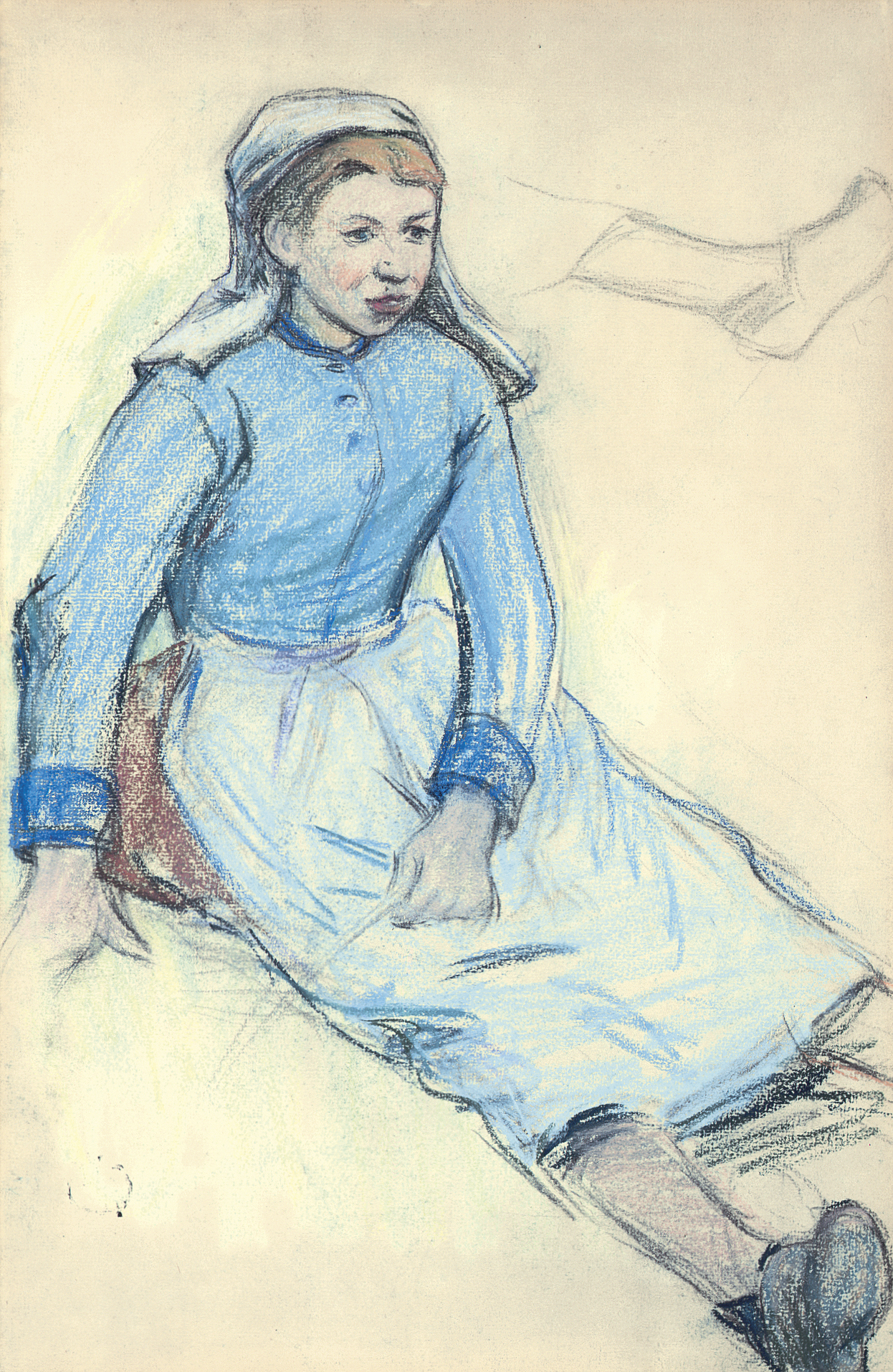
“La jeune femme bretonne”
pastel : 46 x 30,5 cm;
sudio stamp ‘ES’ with lotus monogram (l.l.);
datable to around 1886
"*" indicates required fields
Notes
This work is from a series of studies for a finished version of approximately the same size (CR297), first shown at the important 1958 Hirschl & Adler Schuffenecker exhibition organized by the artist’s daughter Jeanne, as the first showing of her father’s work in the USA. What is not visible in this preliminary version is the branch the young girl is holding in her left hand.
This study was made during the summer visit of the artist to Concarneau in1886, only a few kilometres away from Pont-Aven. It was during this short stay, drawing and painting in this ancient walled city, that he met Emile Bernard.
Claude-Emile Schuffenecker went to Paris at the age of fifteen to study with Paul Baudry, and in 1872 he joined the stock brokerage firm of Paul Bertin where Paul Gauguin was also employed. In the early 1880s, Schuffenecker inherited a small legacy, enabling him to quit his job and become an artist full-time.
Following Schuffenecker’s participation in the eighth and final Impressionist Exhibition in 1886, he and Gauguin (with whom he had spent that winter and spring painting) decided to go to Brittany for the summer with Schuffenecker choosing the fishing village of Concarneau, and Gauguin deciding on the nearby village of Pont-Aven. It was during this period that Schuffenecker established his great friendship with Emile Bernard which would outlast his affections for Gauguin but which friendship would end in 1891.
By then it was clear to Schuffenecker that they held fundamentally different aesthetic perspectives and Gauguin was annoyed with the bourgeois temperament of his friend who chose to invest money in income property rather than lending it to Gauguin. Schuffenecker then learned that Gauguin was having an affair with his wife, Louise.
Schuffenecker, prior to choosing a more ephemeral approach to Impressionism as the style which best suited his contemplative interest in such eastern mysticism as Rosicrucianism and Theosophy, had been very involved with the other aesthetic
explorations of this rich artistic period. Influenced by writings of popular occult figures such as the theosophist, Helena Blavatsky, Schuffenecker created Symbolist landscapes peopled with mysterious, hooded figures and scenes of the Meudon region composed of blurred contours and sinuous lines.
Upon the advent of Divisionism, Schuffenecker loosely followed Seurat’s pointillist technique for several years and was one of the founding members of the 1884 Société des Artistes Independants along with Signac, Cross, Valtat, and Redon, with whom he formed a close friendship from 1891 to the end of Redon’s life. Additionally, he experimented with Symbolism from 1890 to 1896, and had earlier organized the Groupe Impressioniste et Synthetiste exhibition with Gauguin’s help at the Café Volpini in 1889.
However, Schuffenecker was widely known for his astute eye as a collector and had the most important collection in Paris at the turn of the century, including celebrated canvases done by his fellow artists and friends – van Gogh, Cézanne, Gauguin, Redon, Bernard, Degas, Delacroix, and Filiger among others – many of which are now hanging in the major museums of the world. Schuffenecker was first an artist who was always exploring the newest aesthetic experience of the day, but he was also an art theoretician and an avid political and social writer. The subjects of his drawings and paintings included portraits, landscapes in the Ile-de-France, Normandy and Brittany, and his paintings and pastels reflected an impressionist palette integrated within the stylistic inventions of his day.
Provenance
- collection Mme. Jeanne Schuffenecker (the artist’s daughter);
- Hirschl & Adler Galleries, New York, June 1958;
- as a gift to Abraham M. Adler, New York City;
- private collection, San Francisco, USA
Expertise and Literature
This pastel is accompanied by a certificate of authencity from Jill-Elyse Grossvogel and will be included in Volume II of the Claude-Emile Schuffenecker catalogue raisonné. Similar compositions: Jill-Elyse Grossvogel, Vol. I: CR295 and CR296; René Porro, “Claude-Emile Schuffenecker, Une Oeuvre melodieuse”, 1992, p.213, drawing no. 280.
Exhibitions
- New York, Hirschl & Adler Galleries, “Emile Schuffenecker”, Nov.- Dec. 1958, no.31 (illustrated with another image); jub cat 41