
Rembrandt Harmensz. van Rijn
(Leiden 1606 - 1669 Amsterdam)
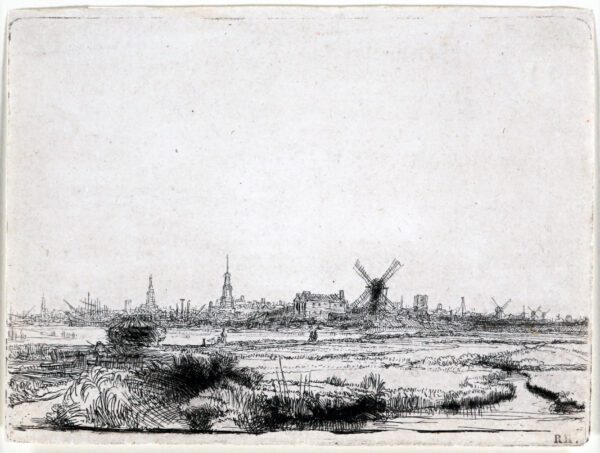
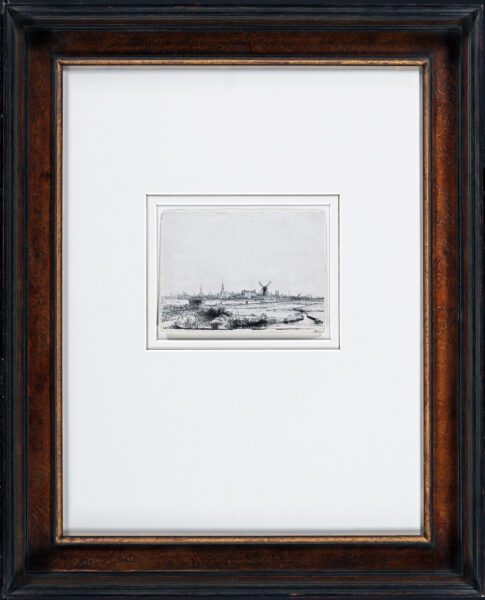
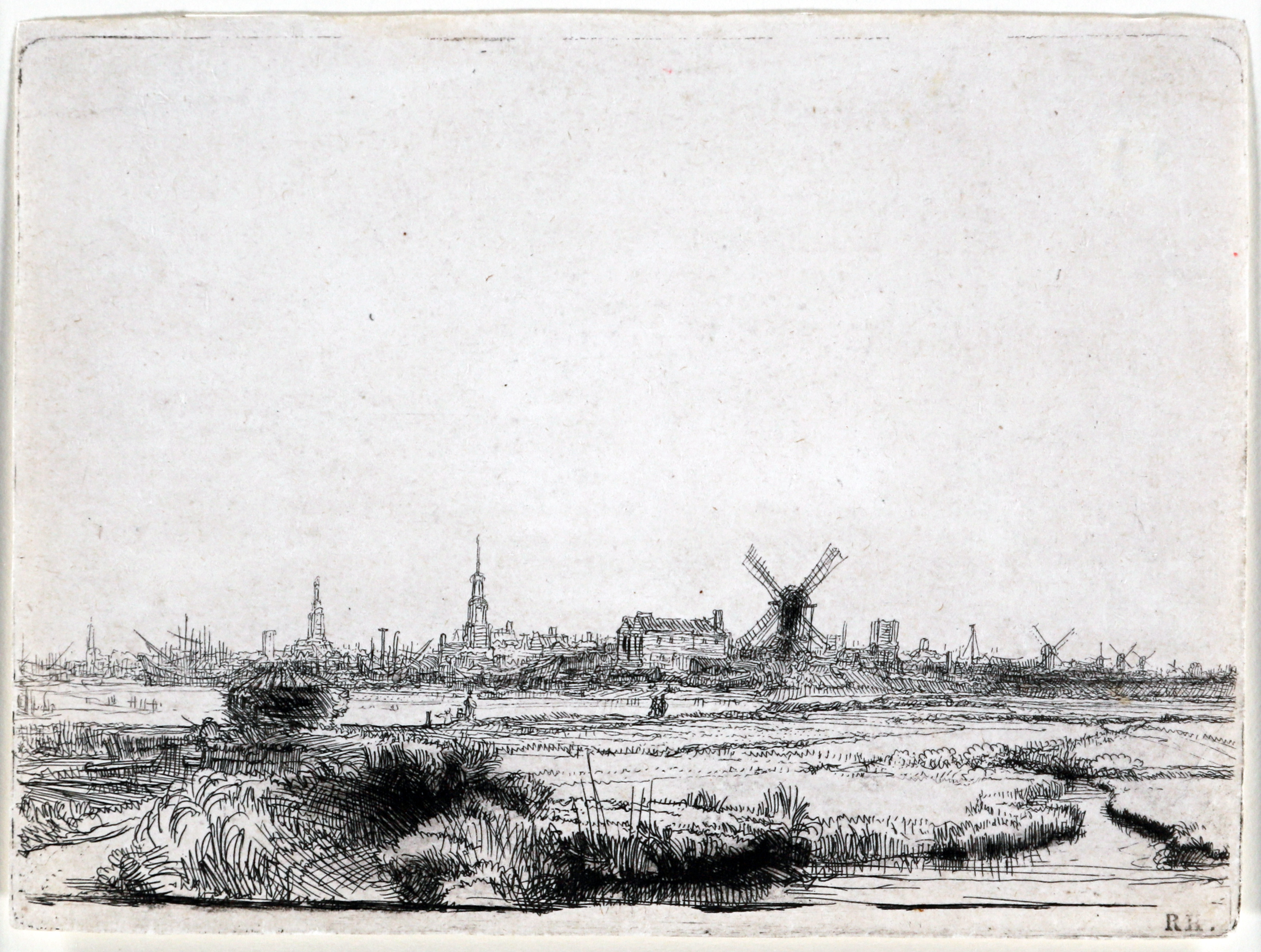
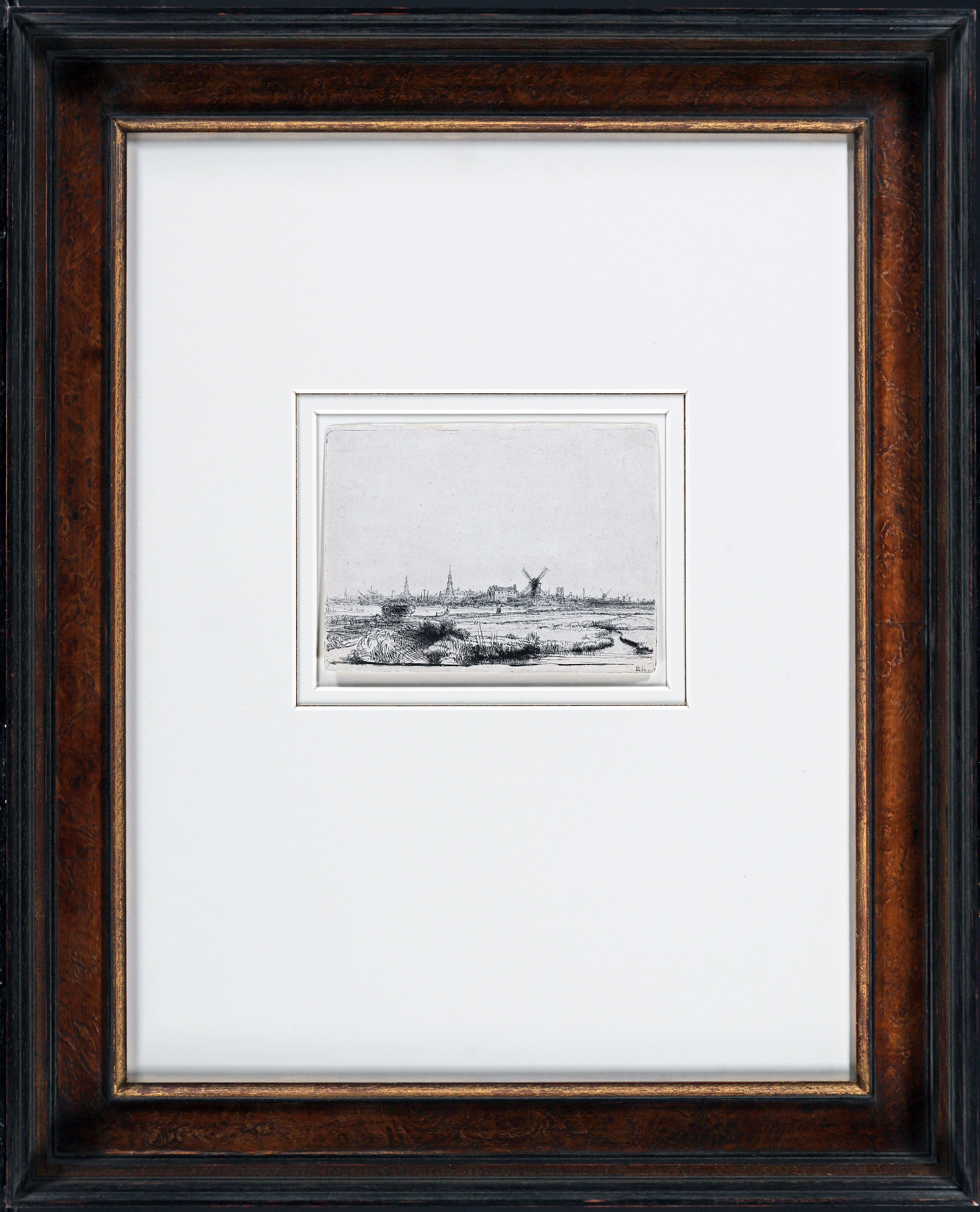
“View of Amsterdam from the Kadijk”, c. 1641
etching: 11,3 x 15,3 cm;
watermark Basilisk, A’a.4 (c. 1640-47)
"*" indicates required fields
Notes
During his lifetime, Rembrandt’s extraordinary skills as a printmaker were the main source of his international fame. Unlike his oil paintings, prints travelled light and were relatively cheap. For this reason, they soon became very popular with collectors not only within, but also beyond the borders of the Netherlands.
Because his father was a miller, Rembrandt must have enjoyed adding the windmill to View of Amsterdam, his first landscape print. The early 1640s marked a flurry of landscape activity for him in and around his adopted city. Several etchings reflect the area near the new house that he and his wife Saskia bought in 1639. Then, after her death in 1642, he may have consoled himself by walking the countryside, with its picturesque old farmhouses. Scholars even speculate that, because Rembrandt ceased making self-portraits in etching around this time, he may have found in nature the sort of meditative self-reflection that he had previously found in self-portraiture.
A superb impression of the only state, with the fine details of the distant landscape at the left edge crisp and strong, and the reeds in the foreground printed in a rich, velvety black. In this view of Amsterdam, Rembrandt achieves extraordinary depth despite the very low horizon. The artist places the reeds and other plants growing along the canal and the footpath prominently in the foreground, while the city appears tiny in the distance. In fact, the tallest reed is as tall as the tallest tower in the city, that one of the Oude Kerk. Eric Hinterding describes the recognisable landmarks from left to right: ‘the Haringspakkertoren, the Oude Kerk, the Montelbaanstoren, the warehouses and jetties of the Dutch East India Company and the mill at the Rijzenhoofd bulwark’ (Hinterding, Lugt Collection, no. 165, p. 284).
The fact that the panorama is depicted in mirror image could indicate that Rembrandt drew it directly on the plate on the spot. If he had started from a prepared drawing, it seems plausible that he would have transferred the drawing to the plate so that it could be printed the right way round.
Provenance
- Richard Houlditch Jr. (? – London – 1736), in the lower right corner with the collector’s stamp (Lugt 2214).
- Private collection, Germany
- Karl & Faber, Munich
- Private Collection, The Netherlands
Literature
Bartsch 210; Hind 176;
The New Hollstein, 2013, no. 203: only state
Plate not in existence – with Nowell-Usticke (1967): R – A scarce print