
Rembrandt Harmensz. van Rijn
(Leiden 1606-1669 Amsterdam)
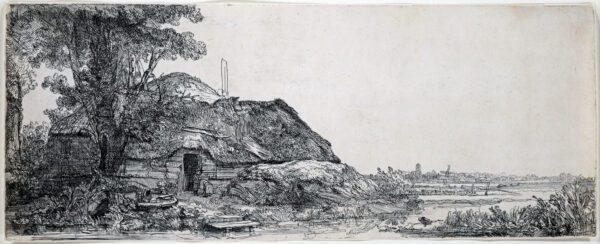
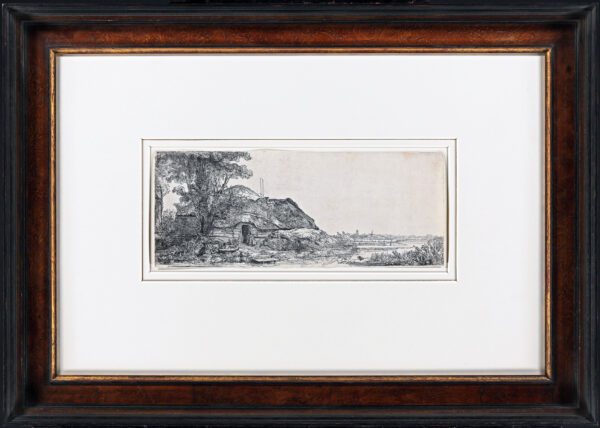
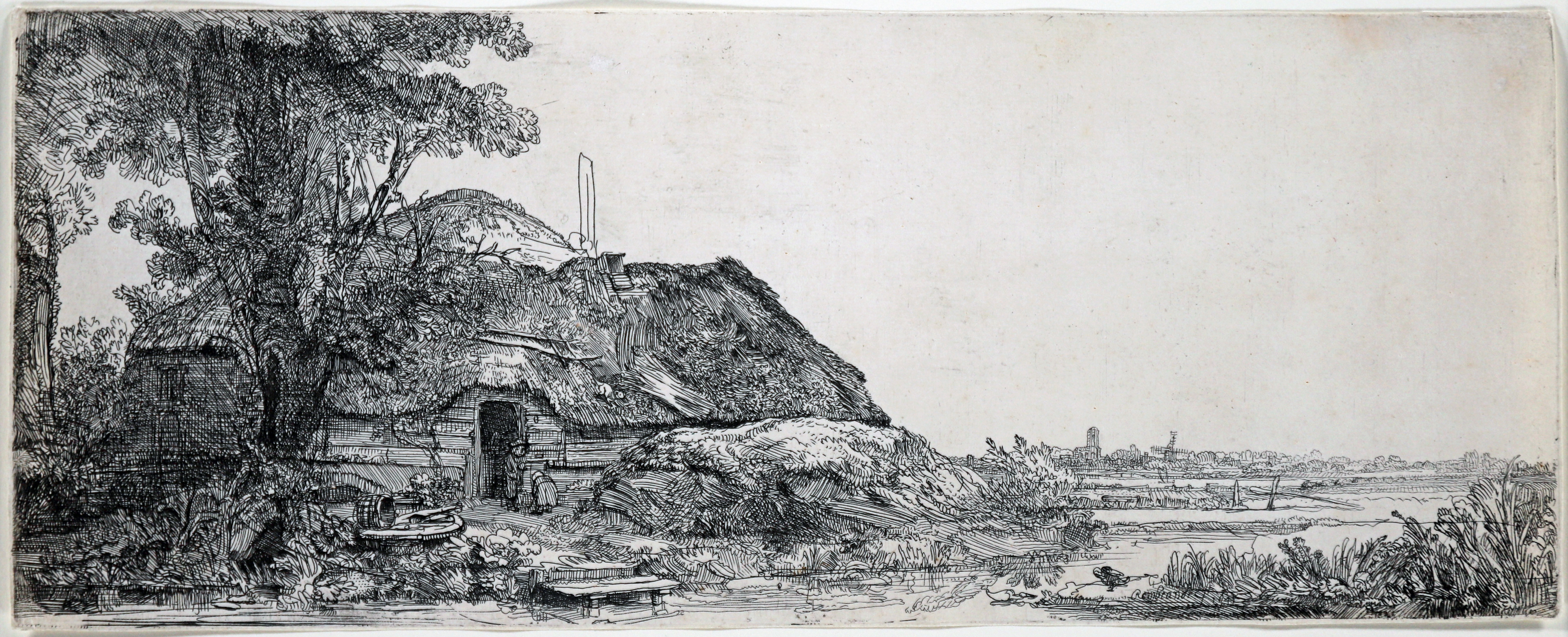
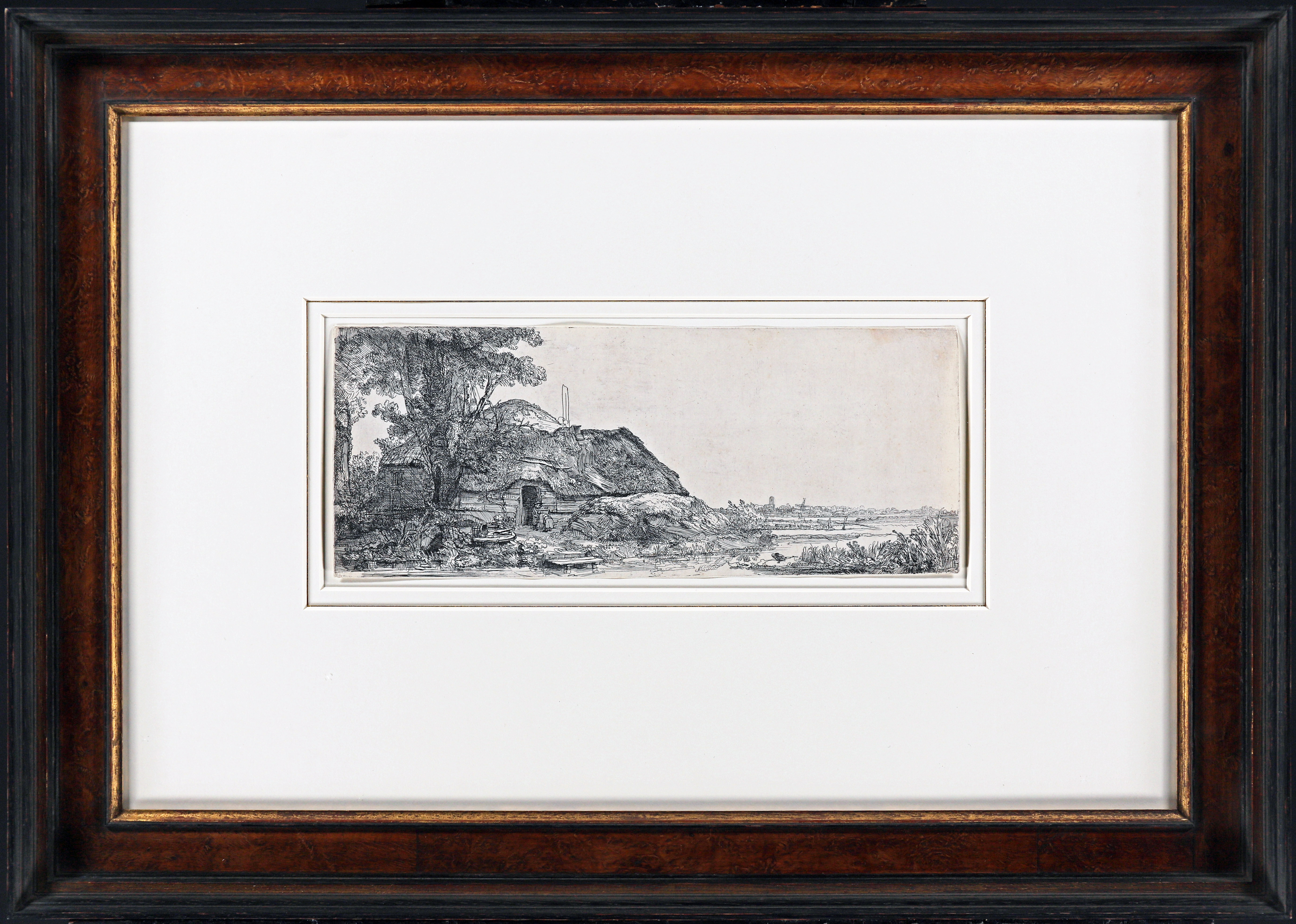
“Landscape with a cottage and a large tree”, 1641
Etching and drypoint: 12,9 x 32,1 cm
signed and dated lower left: ‘Rembrandt f. 1641’
watermark fragment: Strasbourg Lily (dated 1641 in Hinterding)
"*" indicates required fields
Notes
The view of a picturesque cottage is a product of the imagination, a capriccio, inspired by the countryside surrounding Amsterdam. Six (1909, p. 96) observed that the scene combines, unrealistically, a view of Kostverloren with a profile of Amsterdam, even though the city would, in reality, have been situated behind the viewer. A drawing in the Louvre, dating to around 1639 and titled Cottage with a Cart and Road, possibly executed en plein air, appears to have served as the starting point for the left-hand side of the composition.
This is among the earliest of Rembrandt’s landscape etchings, yet the plate is handled with remarkable confidence. In this richly detailed image, Rembrandt successfully evokes a wide range of textures – thatch, foliage, and water – all rendered with a high degree of finish.
Rembrandt’s characteristic inclusion of incidental detail – such as the children by the doorway, the abandoned milk pail and yoke lying by an old cartwheel, and the deteriorating thatch – has led some to suggest an allegorical reading of the plate. While the omnipresent theme of vanitas, so prevalent in seventeenth-century imagery, may indeed have informed his thinking, it remains difficult to determine his intentions with any certainty. It seems likely that he was primarily concerned with issues of representational skill and compositional balance – the very qualities that continue to draw viewers to his work today.
In 1641, Rembrandt made two landscape etchings of the vicinity of Amsterdam. Both images are almost equal in size and belong to his largest landscape prints. The cottage and tree, the two children playing at the door, the two ducks along the water side, and other elements that appear close to the viewer are very deeply bitten, while the distant town has been only lightly etched. Rembrandt would have covered this latter area and then re-immersed the plate into acid in order to create this sharp contrast between foreground and background. It is a technique he gradually abandoned in his later prints, preferring other ways of creating this sense of distance.
As one of the towering figures in the history of art, Rembrandt, a miller’s son from the university town of Leiden, was an artist of unmatched genius. Equally gifted as a painter, printmaker, and draftsman, Rembrandt proved himself to be as skillful at making portraits as he was at creating religious and mythological narratives. His landscapes are just as remarkable as his rare still lifes and subjects detailing everyday life.
Widely recognized as the greatest practitioner of the etching technique in the history of art, Rembrandt created 300 prints that constitute a body of work unparalleled in richness and beauty. During his lifetime, Rembrandt’s extraordinary skills as a printmaker were the main source of his international fame. Unlike his oil paintings, prints travelled light and were relatively cheap. For this reason, they soon became very popular with collectors not only within, but also beyond the borders of the Netherlands.
Provenance
- Private collection, Germany
- Karl & Faber, Munich
- Private collection, The Netherlands
Literature
Bartsch 226; White/Boon 226;
The New Hollstein Dutch, 2013, no. 198: only state
Plate not in existence – with Nowell-Usticke (1967): R