
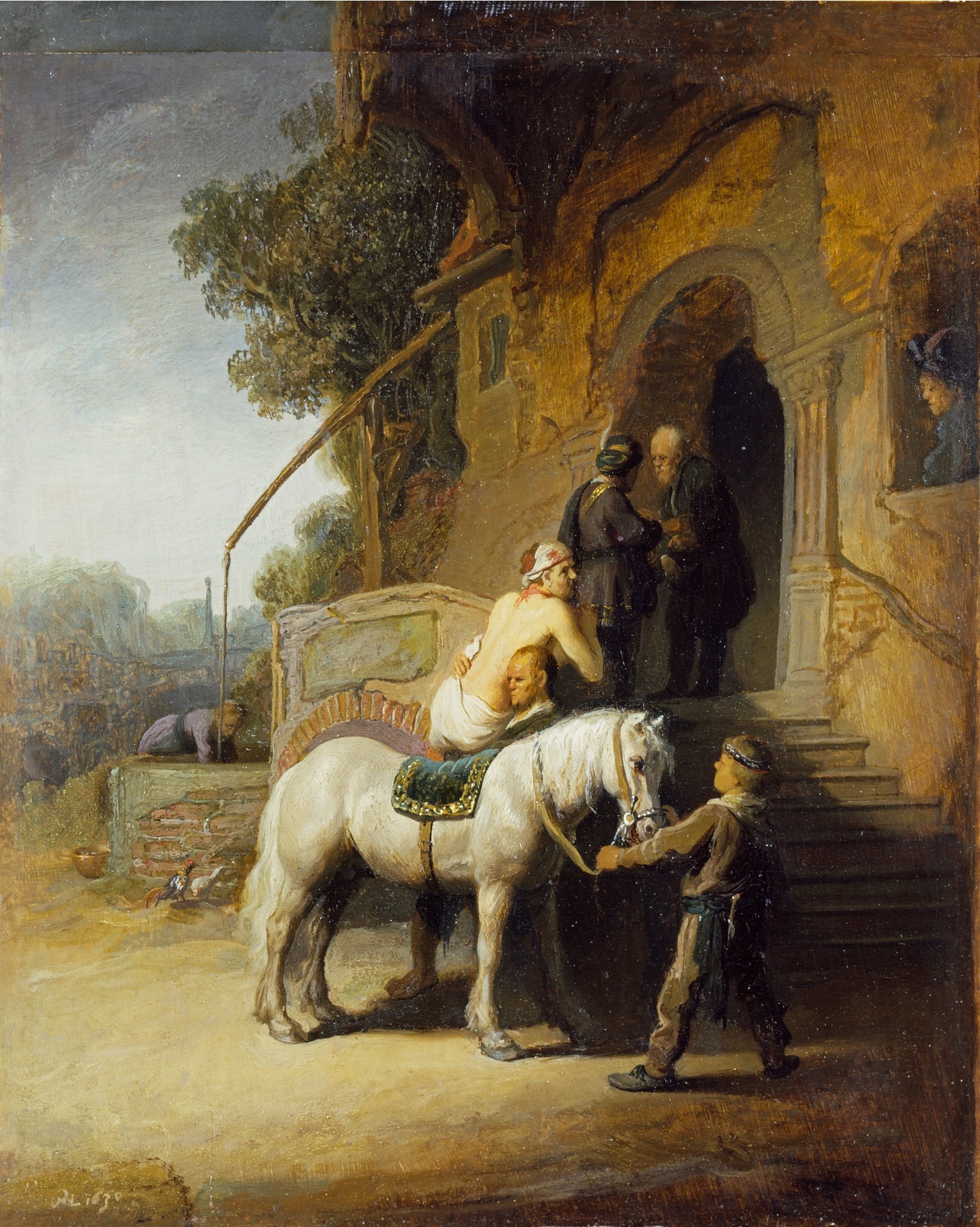
Rembrandt Harmensz. van Rijn
(Leiden 1606-1669 Amsterdam)
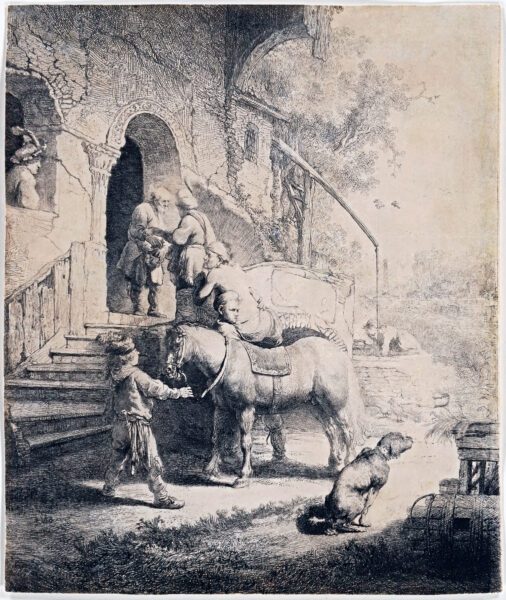
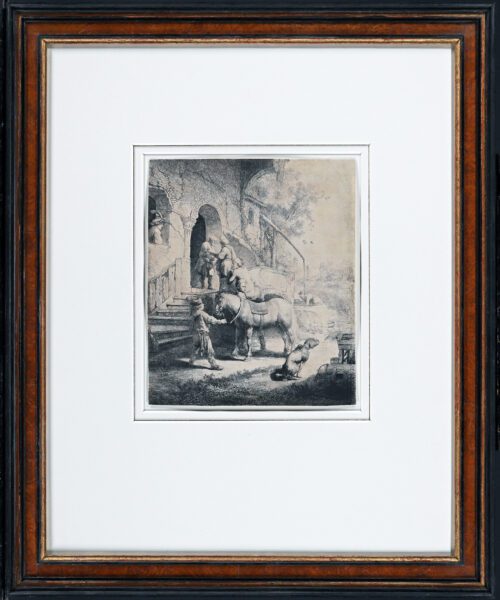
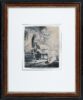
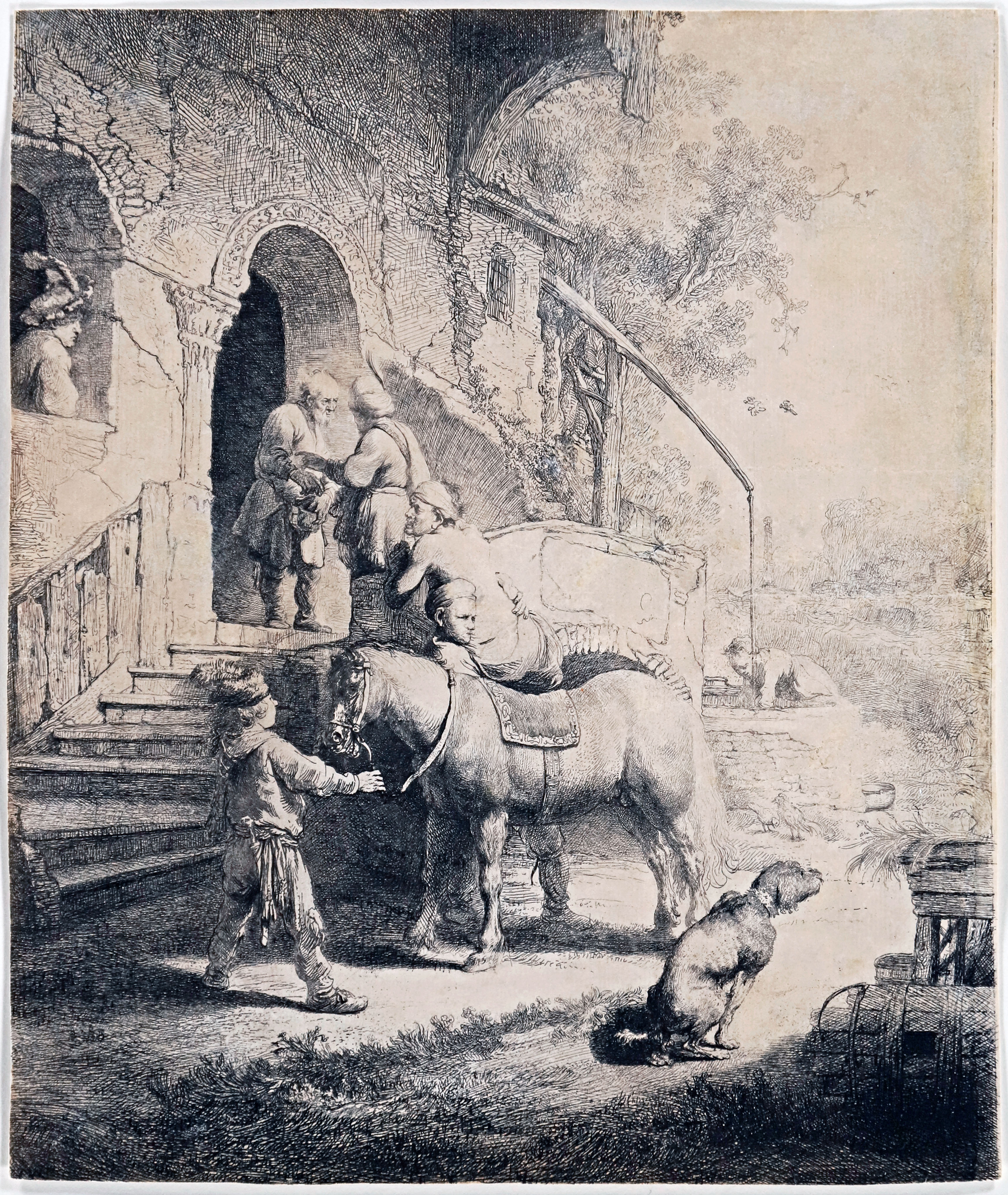
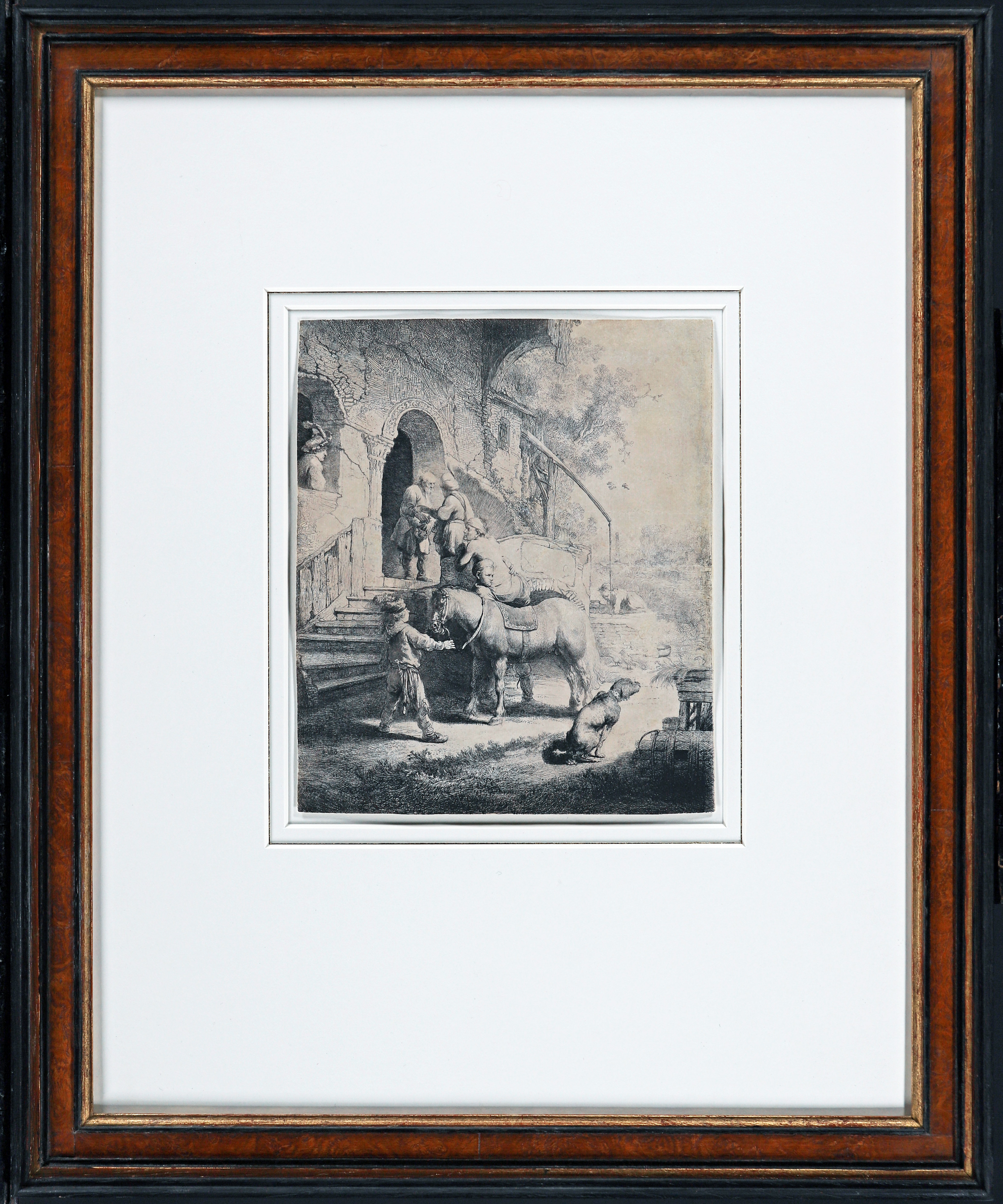
“The Good Samaritan”, 1633
etching, engraving and drypoint on laid paper: 23,9 x 20,2 cm
Watermark: Arms of Burgundy and Austria (Hinterding A.a.a.). (1633)
"*" indicates required fields
Notes
A superb impression of the extremely rare first state, before the shading of the horse’s tail and the completion of the wall above the horse. With beautiful contrasts and tonal balances. Trimmed to the image (since there was a wide space between the platemarks and the image, there are only a few surviving impressions that were not trimmed to the image). Rembrandt only signed and dated the etching in the fourth state.
Rembrandt presents an interpretation of the Parable of the Good Samaritan (Luke 10:25–37). A man, left injured by robbers, is ignored by a priest and a Levite before a Samaritan – socially marginalised at the time – offers help. The scene underscores Christ’s message: true compassion lies not in social status, but in action.
Rembrandt depicts the moment the Samaritan arrives at the inn. He entrusts the wounded man to the innkeeper, handing over money for his care. The surrounding scene is rich in everyday detail: a dog relieves itself in the foreground, water is drawn from a well, and servants tend to horse and rider. The inn, once grand, now shows signs of decay – a visual metaphor for moral and material decline.
Created during Rembrandt’s early Amsterdam years, the work exemplifies his growing interest in emotional depth and human psychology within biblical narratives. Technically, the etching demonstrates his command of light, texture, and atmosphere.
During his lifetime, Rembrandt’s extraordinary skills as a printmaker were the main source of his international fame. Unlike his oil paintings, prints travelled light and were relatively cheap. For this reason, they soon became very popular with collectors not only within but also beyond the borders of the Netherlands.
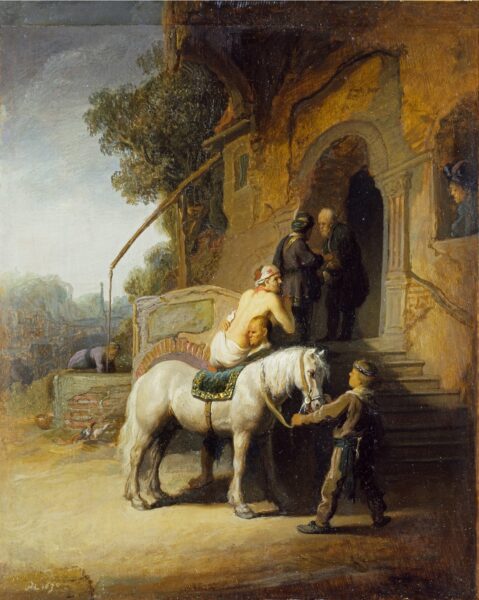
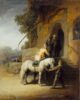
This print is one of the only etchings that Rembrandt also painted three years earlier and that can now be seen at the Wallace Collection in London.
The painting is signed on the stone in the bottom left-hand corner with Rembrandt’s monogram ‘RHL’, which he employed during his early career in Leiden between1624–32, and is dated 1630. The date of execution accords well with the style of the picture, which displays the bright palette and smooth manner of Rembrandt’s Leiden period. An etching by the artist, completed three years later, corresponds so closely to the composition that it appears that it was traced directly from the painting. In the etching, Rembrandt added a dog and several other details to the foreground of the composition which are absent in the painting. It seems unlikely, however, that the painting was intended as a design for the print (as was once believed), rather Rembrandt propably created the etching to record the composition of the painting.
Provenance
- Private collection, Germany
- Karl & Faber, Munich
- Private collection, The Netherlands
Literature
Bartsch 90; The New Hollstein no. 116: First state (of IV)
Plate not in existence – with Nowell-Usticke (1967):
R+: “A very scarce plate, seldom found in fine condition”